

Having feelings that are not returned can be painful, whether the person is a friend, a former partner or someone you have been dating. You may be grieving both the connection and the future you imagined. Their feelings do not determine your worth.
You do not need to label yourself as too attached or prove that the other person is flawed. A useful starting point is to take their answer seriously, notice what contact is doing to you and choose support that makes everyday life more manageable.
On this page
1. Separate your wishes from their answer
Ask yourself what you were hoping for: a date, exclusivity, affection, reassurance or a shared future. Naming the wish can help you understand the loss without assuming that every part of it was an agreement between you.
If the situation is genuinely unclear, one direct, respectful question may help: “Are you interested in a romantic relationship with me?” Give the person room to answer without offering favours, repeated arguments or a promise to wait indefinitely.
A clear no deserves respect. Kindness, friendship, physical intimacy or a history together does not cancel that answer. You can be disappointed while accepting that a relationship requires willing participation from both people.
2. Allow sadness without turning it into a verdict
You may feel sadness, embarrassment, anger, relief or several feelings at once. You do not have to make the experience inspiring or pretend to be positive for other people. You can also enjoy an ordinary moment without proving that you have finished grieving.
Try noticing the difference between a feeling and a conclusion: “I feel unwanted today” is different from “Nobody will ever want me.” The first names your experience; the second predicts an entire future that you cannot know.
Choose one small form of support, such as a meal with a friend, a walk or a quieter evening. If the distress persists or affects sleep, work or your ability to care for yourself, consider speaking with a qualified mental-health professional.
3. Choose contact that you can manage
Remaining close may be comfortable for some people and painful for others. You can reduce one-to-one time, stop flirting, mute social updates or take a break from hearing about their dating life. Choose a limit for your wellbeing rather than as a strategy to make them miss you.
You do not have to keep yourself available in case the person changes their mind. You can leave the future open without waiting for a particular outcome. Their uncertainty does not require you to put your plans on hold.
If you share work, family responsibilities or a social group, total separation may be impractical. Keep necessary contact focused: agree on the topic, use a suitable channel and leave personal discussion for another time. You can say, “I can discuss the arrangement, but I am not ready to talk about dating.”
4. Look at what the connection actually offered
Consider what was actually present: mutual interest, availability, shared plans or mainly hope. You can appreciate real kindness while recognising that the relationship you wanted was not being offered.
Seeing someone more fully does not mean collecting their faults until you stop caring. It means allowing ordinary limitations, differences and their own choices into the picture. You do not need to turn them into a villain to step back.
If you missed a cue or made an assumption, identify what you would ask more clearly next time. That is a practical lesson, not evidence that you caused the rejection. No attachment label can establish why this particular person does not want the same relationship.
5. Return to your own life at your own pace
Reconnect with parts of life that are not organised around their attention. You might make a plan with another friend, return to an interest or decide how to use a weekend that you had kept available for them.
Dating again is optional. You can take a break, meet people slowly or decide that romance is not your priority. You do not need another person to prove that you have recovered, and a new date deserves to be met as an individual.
Love can remain meaningful even when it is not returned, but it does not obligate you to keep giving beyond your limits. Respect their choice and your own needs together. The next step can be small: less checking, clearer contact or one plan that belongs to you.
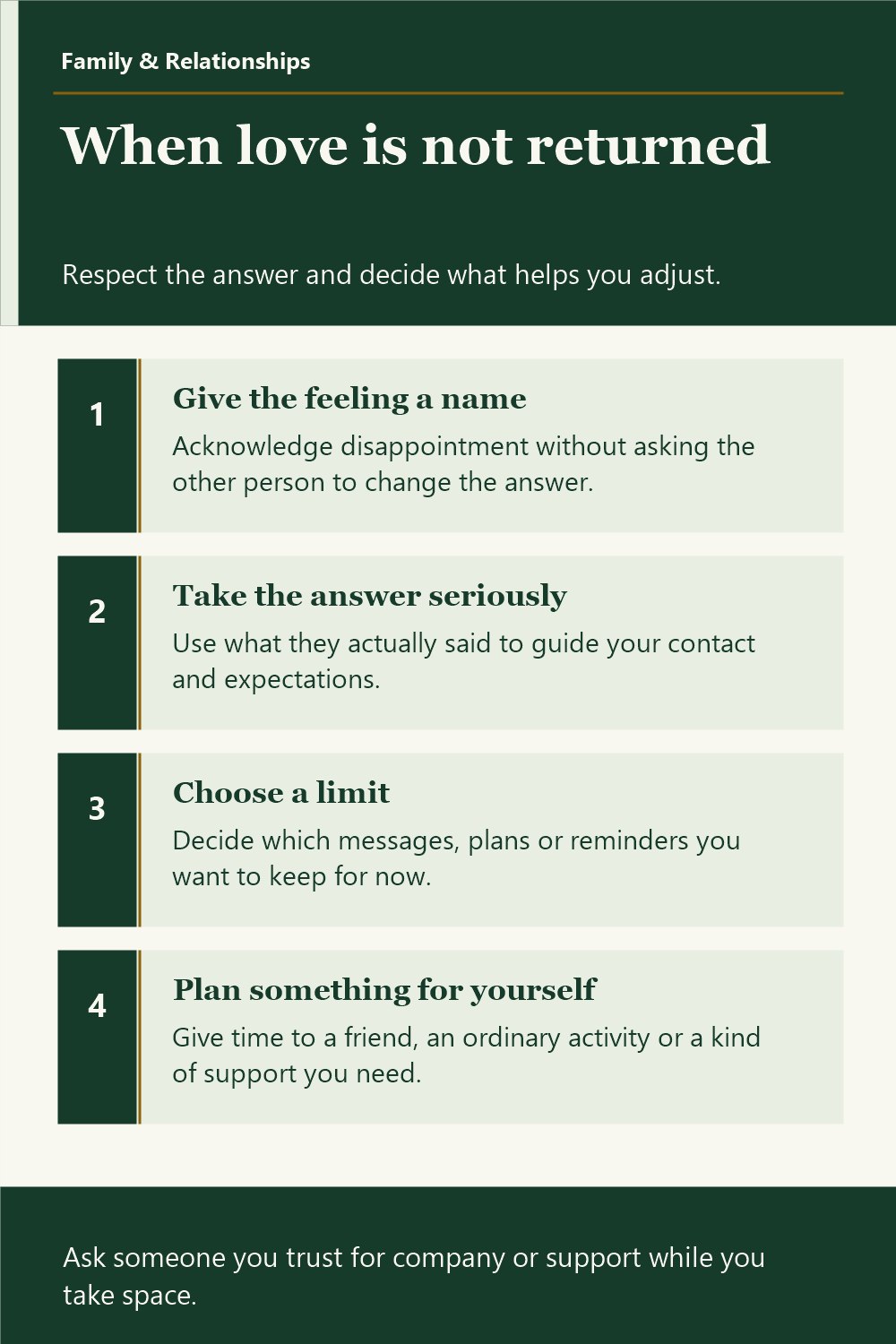
Read the infographic in text
When love is not returned
Respect the answer and decide what helps you adjust.
- Give the feeling a name Acknowledge disappointment without asking the other person to change the answer.
- Take the answer seriously Use what they actually said to guide your contact and expectations.
- Choose a limit Decide which messages, plans or reminders you want to keep for now.
- Plan something for yourself Give time to a friend, an ordinary activity or a kind of support you need.
Ask someone you trust for company or support while you take space.