

A message from an ex can bring relief, hope, irritation or worry, sometimes all at once. You do not need to answer immediately to be polite. Before replying, consider what the message concerns, what contact you want and whether a response is safe.
A practical question about a shared bill needs a different decision from a late-night invitation or repeated unwanted messages. You cannot reliably determine someone’s intentions from a nostalgic sentence, a song or the time a text arrived.
On this page
Decide whether a response serves a purpose
Ask what needs an answer. Is there a deadline, a shared responsibility or a question you genuinely want to discuss? If there is no practical urgency, give yourself time to decide.
You can choose friendly contact when both people want it, a temporary pause or no social conversation. Friendship after a breakup is not an obligation, and replying once does not commit you to continuing.
If safe, a clear sentence may help: “I am not looking to restart the relationship,” or “I can discuss collecting the remaining things by email.” You do not need to repeat the whole history or prove that your reason is good enough.
Take threats and repeated unwanted contact seriously
Repeated messages after you have declined contact, threats, monitoring or unexpected appearances deserve support. An apology does not require you to resume conversation or meet in person.
The National Domestic Violence Hotline’s stalking guidance notes that blocking contact can sometimes lead to retaliation. If you fear the person, a domestic-abuse or stalking advocate can help you consider a plan before changing contact or account access. Use a safer device if monitoring is a concern.
Keep messages or an incident record only when you can do so safely. The Safety Net Project’s documentation guidance explains that some apps notify people about screenshots and that records themselves may create risks. You do not need a perfect evidence file before asking for help.
If there is immediate danger, contact local emergency services when you can safely do so. Another person’s harassment is their responsibility, not a consequence of failing to phrase a boundary correctly.
Consider reconciliation through actions and agreement
If you are interested in talking about getting back together, separate missing each other from deciding to restart. What led to the breakup, what has changed and do you both want the same arrangement now?
Look for specific, sustained changes rather than promises made in one emotional exchange. You can take time, ask questions or decide that affection is not enough to resolve incompatible plans.
Participation in counseling is not proof that someone is now safe, and you are not required to test whether they have changed. These ideas about hurtful or controlling patterns may help you consider support alongside your choices.
Keep necessary contact clear and limited
If you share parenting, property or other responsibilities, identify what information must be exchanged and through which channel. A practical message can stay with one topic: “The appointment is Tuesday at four. Please confirm the transport arrangement.”
Discuss workable response times and a separate way to address genuine urgent matters, where safe and appropriate. Avoid using a child to pass messages or asking them to report on the other parent.
Existing court orders or agreements may affect communication. Get independent local advice if you are unsure what applies. Joint mediation is not automatically suitable where there is abuse or intimidation; ask a qualified adviser about safer options.
Make room for support after the conversation
A reply can stir up grief even when you do not want the relationship back. You might step away from the phone, speak with someone you trust or make a small plan for the rest of the day.
If distress is persistent or affecting daily life, a qualified counselor or healthcare professional can help. There is no requirement to recover quickly. These suggestions for moving on after a relationship offer further practical support without requiring a particular contact rule.
Read the infographic in text
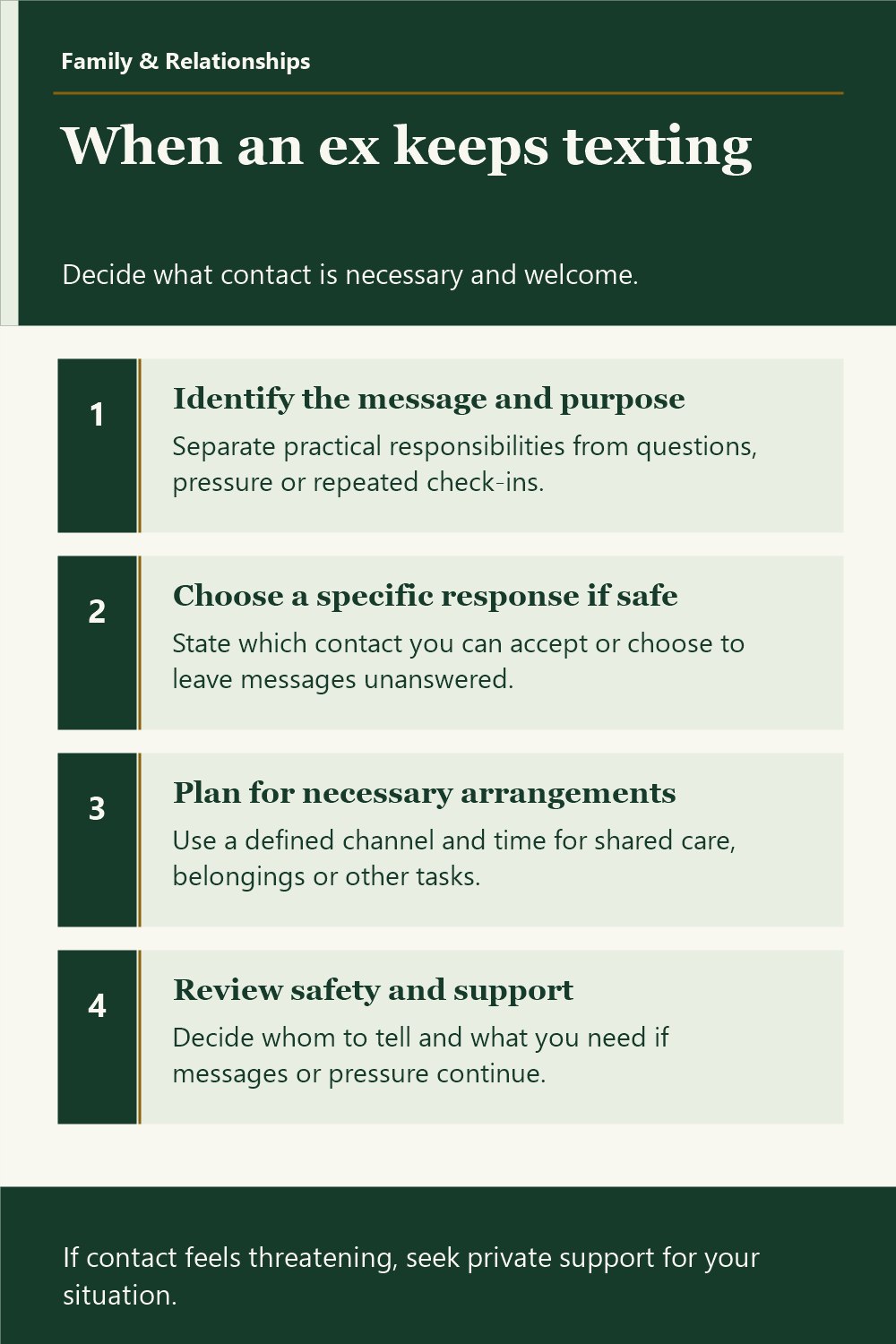
When an ex keeps texting
Decide what contact is necessary and welcome.
- Identify the message and purpose Separate practical responsibilities from questions, pressure or repeated check-ins.
- Choose a specific response if safe State which contact you can accept or choose to leave messages unanswered.
- Plan for necessary arrangements Use a defined channel and time for shared care, belongings or other tasks.
- Review safety and support Decide whom to tell and what you need if messages or pressure continue.
If contact feels threatening, seek private support for your situation.