

Family boundaries describe what you can offer and what you need to keep private. A clear limit can make contact more sustainable: a planned visit, a shorter call or a caregiving task with a defined owner.
You can care about relatives without being endlessly available. Start with one recurring problem and a response you can realistically carry out, taking safety and dependence into account.
Turn a recurring problem into a workable limit
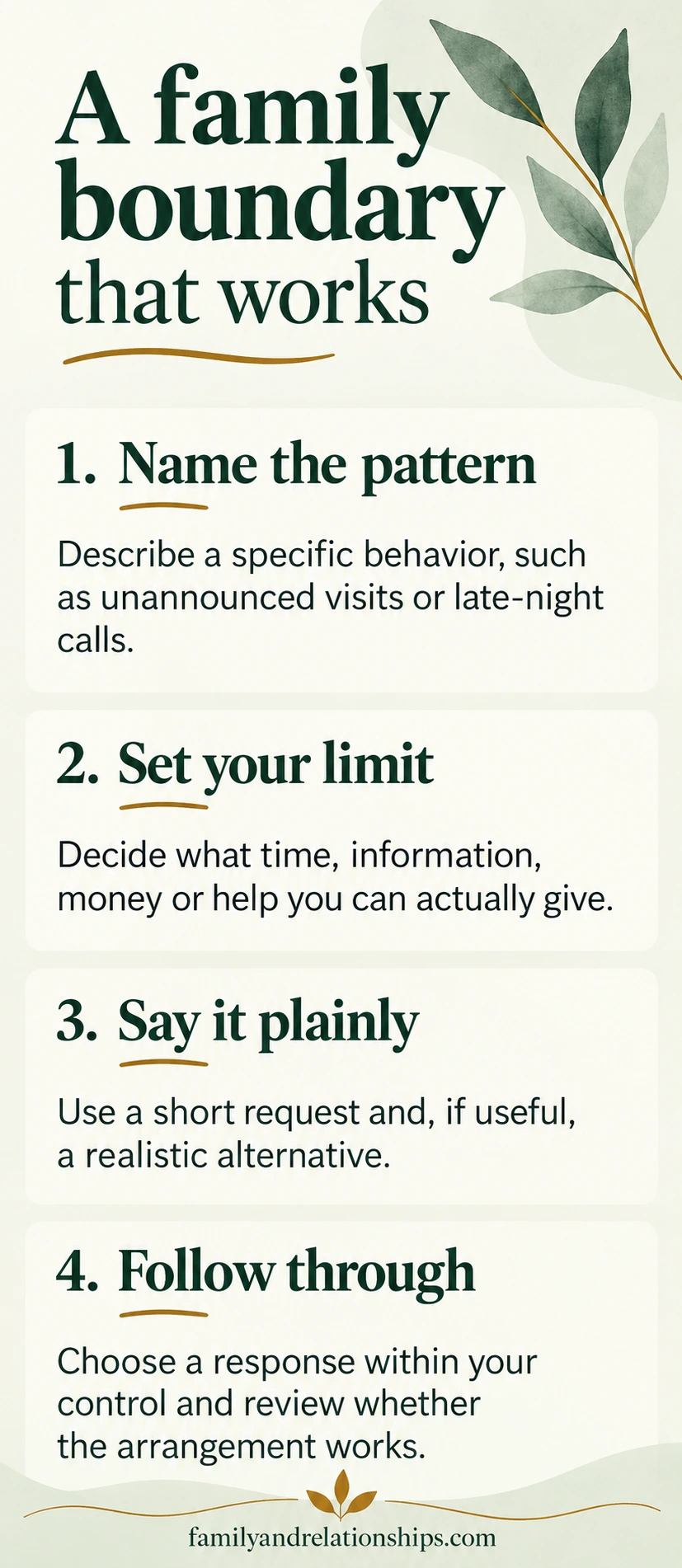
Read the guide as text
- Name the pattern. Describe a specific behavior, such as unannounced visits or late-night calls.
- Set your limit. Decide what time, information, money or help you can actually give.
- Say it plainly. Use a short request and, if useful, a realistic alternative.
- Follow through. Choose a response within your control and review whether the arrangement works.
Seeing the Problems That Keep Returning
If you tell someone to respect your boundaries, this is a broad statement. You need to describe what has happened, such as showing up unannounced, commenting on your body, or late-night calls.
Write down what is happening and how it is affecting you and what would make it easier. Don’t try to fix the entire family before you have a conversation. If you feel tense when you call your mother, look at the relationship closer. Maybe you see that the hard part is being expected to call or answer during bedtime when the kids are lying down. Having a regular afternoon call could address the issue without reducing the contact.
Being specific helps you to pick the right response. You might need a different visiting schedule, to say things you won’t talk about, or to pause if things get heated. These are different needs, and one rule might not work for them all.
Deciding Your Limits
A request asks someone to act differently: “Please call before visiting.” A boundary describes your own availability: “I can welcome visitors when we have arranged a time.”
You can talk about both of these, and the difference matters because you can’t make someone agree, understand, or stop being disappointed, but you can decide if you want to continue a conversation, lend money, or open the door.
A limit can describe your availability without trying to control another person’s feelings. Think of a limit as information about your availability, rather than a sentence designed to produce a perfect reaction.
Avoid consequences that you don’t mean, or you can’t do. If you depend on housing or care, you might need to make smaller changes or get support outside. A real boundary is more useful than declaring that what they do puts you at risk.
Set Boundaries in a Way That Feels Natural to You
Setting boundaries with family members doesn't mean that you have to sound overly serious or use complicated words. Sometimes the best way to explain what you need is to be kind, honest, and direct. You can let someone know that you care about them while still explaining what you're comfortable with and what you aren't. If there's another option that works better for you, it's okay to suggest it, but you don't have to offer something else every time you say no.
Maybe you like spending time with your family, but you don't like it when relatives stop by your house without letting you know first. You could say something like, "I love having you over, but it's hard when you show up without calling. Can you let me know ahead of time so we can plan something?" This explains what you need without making the other person feel that you don't want to see them.

It's also important to remember that saying no doesn't mean you have to make up for it by doing something else. If a relative asks to borrow money and you aren't comfortable lending it, you can just explain that you're not able to help financially. You don't have to offer another favor just because you feel guilty about turning down their request. If you do offer an alternative, make sure it's something you genuinely want to do and can follow through with.
Stay Calm When Possible
Make sure you keep your boundaries when you have conversations, especially if they want to argue with you. You can explain the new arrangements during a good conversation. Ask if now a good time is and say something like, “Can we talk about our visits for a few minutes?” This is being kind and doesn’t mean that they will give you permission to talk about it.
If you aren’t able to talk about it, then write an email. Remember this can be forwarded to everyone else, so it only includes information you want to share. You don’t have to have a detailed account for everything that hurt you.
If you’re talking and it can lead to eviction, violence, or withdrawal of care, seek support before you make the change. Communication advice means that you are safe enough to disagree, and it doesn’t remove power imbalances or dangerous situations.
Creating Boundaries
Treat your limits as actual times. You might say something like, “I’ll call on Sunday, but I’m not answering messages during work,” and this is better than saying, “I need more space.”
For visits you can decide when they start and when they end. Making a plan is important and you should arrange transportation that lets you leave when you say you are instead of relying on someone to get you if they want to stay longer.
You can also change how often you see someone or do something for them. A monthly meal might fit your life better than once a week. Closeness shouldn’t mean how much time you give, and if your relative lives far away, don’t be constantly available if it causes you stress.
Calling briefly or scheduling a video call can keep the connection strong. The goal is to do something you can do willingly and not to schedule something that is overwhelming to you.
Keep personal information private with clear words
Sometimes family members believe that because they love you and care about your happiness, they should know everything that's happening in your life. While their concern might come from a good place, that doesn't mean you're obligated to share every personal detail. Things like your finances, medical concerns, decisions about having children, relationship problems, or your children's experiences are all subjects you have the right to keep private.
You can appreciate someone's concern without answering questions that make you uncomfortable. For example, if a relative keeps asking about something personal, you might say, "I appreciate you checking on us, but we're keeping that private for now. If we need help or want to talk about it, we'll let you know." This allows you to acknowledge their concern while making it clear that you aren't ready to discuss the situation.
You also don't have to make up reassuring details or promise to give someone an update later just because they keep asking. Sometimes family members might continue bringing up the same subject because they believe they're being helpful. If that happens, it's okay to repeat your answer without getting into a long explanation. Setting a boundary doesn't mean you don't love or trust your family. It simply means that some parts of your life belong to you.
Privacy also includes what family members share online. For example, you might be comfortable having your picture taken at a family gathering but not want it posted on social media without your permission. Instead of assuming everyone understands your preferences, you could say, "Please ask me before posting pictures of me or my family." When children are involved, it's especially important to think about information such as their schools, locations, and everyday routines that might be visible in pictures or posts.
If someone has already shared something you wanted to keep private, try explaining exactly what you'd like them to do. You might ask them to remove a picture, change a caption, or stop forwarding messages that were meant to stay between family members. You don't always have to argue about whether they meant to upset you. What matters is whether they're willing to respect your request and handle your personal information more carefully in the future.
You can also pay attention to how family members respond when you set these boundaries. If someone repeatedly shares private information after you've asked them not to, you might decide to be more careful about what you tell them. Protecting your privacy isn't about pushing people away. It's about having control over which parts of your life you're comfortable sharing.
Be Honest About What You Can Afford to Give
Money can be a hard subject to talk about with family, especially when someone you love is struggling financially. You might genuinely want to help, but you also have your own bills, responsibilities, and financial goals to consider. Sometimes family members might make you feel guilty for saying no, even when helping would create problems for you. That's why it's important to think about what you can realistically afford before agreeing to give or lend money.
One thing that can help is deciding ahead of time how you want to handle requests for financial assistance. For example, you might decide that you don't lend money to family members because you've had problems with repayment in the past. If someone asks, you could simply say, "I'm sorry you're going through this, but I'm not comfortable lending money." You don't have to explain every detail about your finances to justify your decision.
In other situations, you might decide that you're comfortable giving someone a small amount of money without expecting it back. If that's the case, it's better to be clear that you're giving them a gift instead of calling it a loan. Lending money can create problems when one person expects repayment and the other assumes that family shouldn't have to pay it back. Being honest about your expectations from the beginning can help avoid misunderstandings.
If you're thinking about lending a larger amount of money, take time to discuss things like repayment, deadlines, and what would happen if the person couldn't pay you back. Depending on the amount involved, getting financial or legal advice might also be helpful. Try not to make major financial decisions simply because someone is upset or pressuring you to help immediately.
For example, someone may care about a sibling who needs help with rent while being unable to cover it without missing their own essential bills. A clear refusal can be kinder than a promise they cannot afford to keep.
Sharing Caregiving and Tasks
Caregiving can make boundaries hard. Someone might need real help, but one might be the organizer of everything. List the tasks such as booking appointments, making meals, doing paperwork, and shopping.
Talk about ownership, such as, “Could you be responsible for booking appointments and transporting them on Tuesdays?” Saying this is better than saying, “Please help me more.” And this can tell you when someone is unavailable.
A limit can be that you can give care on these two evenings, but for the rest of the days you can't. If this is more than what you can do, then look for community services and professionals. You don’t have to wait for something bad to happen to make the arrangement not workable. A person’s care needs and your limits are both able to be real.
Feeling Guilty without Changing Your Decisions
A relative might tell you that you’ve changed or that you’re selfish. You can talk about those emotions without changing what you’re doing. You might say something like, “I understand you wanted me to stay longer, but I have to leave at 3. I know you’re disappointed.”
The Centre for Clinical Interventions offers resources for communicating clearly while respecting other people. Practice can help you stay with the actual request rather than becoming drawn into a judgment about your character.
Don’t expect them to comfort you. Feeling guilty can be something you’re unfamiliar with, and it can be a conflict of responsibility or something you have to reconsider. This is a feeling and isn’t proof that your boundary is unfair. You can think about it without getting rid of your boundaries at the moment.
Don't Feel Like You Have to Keep Explaining Yourself
Sometimes when you set a boundary with a family member, the conversation keeps going in circles. You might explain why you can't do something, but the other person continues asking questions, suggesting alternatives, or trying to change your mind. When this happens, giving more explanations doesn't always help. In fact, it can sometimes make things more frustrating because every new reason gives the other person something else to argue about.
Instead of continuing to defend your decision, try keeping your response short and simple. For example, you might say, "I've already explained what I'm comfortable doing, and I don't want to keep discussing it tonight." If the conversation continues, you can change the subject or politely end the call when it's safe and practical to do so. You don't have to stay in an argument just because someone doesn't agree with your decision.
It's also important to remember that standing by your boundaries doesn't mean you have to be rude or hurtful. You can remain calm, respectful, and understanding even when the other person is disappointed. You don't need to make them feel bad for disagreeing with you, and they don't have to be happy about your decision for it to be valid. Sometimes people need time to adjust to boundaries they're not used to hearing.
There might also be times when you become frustrated and say something in a way you regret. If that happens, it's okay to apologize for how you handled the conversation without changing your original decision. For example, you could say, "I'm sorry I raised my voice earlier. I was frustrated, but I still can't take on that responsibility right now." This allows you to take responsibility for your behavior while still being honest about what you can and can't do.
Remember that apologizing for losing your temper doesn't mean you have to give in. How you communicate and what you're willing to do are two different things. You can recognize that a conversation could have gone better while still standing by a boundary that's important to you.
Understand That Every Family Has Different Expectations
Every family has its own traditions, beliefs, and expectations about how relatives should treat each other. In some families, spending time together regularly is extremely important, while others might be more comfortable giving everyone their own space. Some families expect relatives to help each other financially, share personal information, or take on certain responsibilities. These expectations can also be influenced by culture, upbringing, and the roles people have held in their families for years.
Because of these differences, setting a boundary might feel completely normal to you but seem unusual or upsetting to another family member. That doesn't necessarily mean either person is trying to cause problems. Sometimes people are simply used to doing things a certain way. Understanding where those expectations come from can help you explain your needs in a way that's respectful without feeling that you have to give up what's important to you.
Maybe your family expects you to visit every weekend, but your work schedule and other responsibilities make that difficult. Instead of continuing to agree to visits that leave you exhausted, you might say, "I really enjoy spending time with everyone, but I can't keep making plans every weekend. I'd rather plan visits when I know I'll have the time and energy to enjoy them." This helps your family understand that you're not trying to avoid them. You're simply being realistic about what you can manage.
It's also important to recognize that setting boundaries isn't equally easy for everyone. If you're living with family members, depending on someone financially, dealing with a disability, or facing concerns involving your immigration status, you might not have the same freedom to make changes as someone who lives independently. In these situations, making major decisions without considering the possible consequences could create more problems. Talking privately with a qualified professional or a trusted community organization might help you understand your options and find ways to protect your needs.
Try not to compare your progress with someone else's situation, either. Maybe another person can easily tell a relative that they won't accept unannounced visits, while you're still working toward having family members knock before entering your bedroom. Someone else might feel comfortable discussing their finances openly, while you're learning how to keep certain medical information private. These might seem like small changes, but they can still be important steps toward having healthier boundaries.
The goal isn't to make your family relationships look like anyone else's. It's to find ways to respect your own needs while considering the circumstances you're living in. Sometimes that means making gradual changes instead of trying to change everything at once. Even small boundaries can help you feel more comfortable, respected, and confident in your relationships with the people you love.
Let Contact Be Sustainable
After you set a boundary, see the results of it. Do you feel less rushed, and are there less arguments? Are you able to keep the arrangement without having to constantly change things?
A family member might need to be reminded of things or to have alternatives. You can consider these things without looking at every limit as negotiable. If there are repeated violations, then you need to change what you’re in control of. You might shorten the visit, give less information, meet in a different place, or take a pause. Having more distance can be appropriate if the goal is to stay close.
You don’t have to explain yourself until someone approves, but at the same time, sometimes a disagreement can be solved through more clarification. Look at the pattern instead of just thinking that instant peace or ignoring each other is required.
Build a family-boundary sentence
Choose a recurring situation for example wording and a follow-through you can adapt.
A clear sentence cannot guarantee a cooperative response. Choose a response that is within your control and safe in your circumstances.
Use the questions and examples in the article above; the draft builder needs JavaScript.
15 questions readers ask
1. What is a family boundary?
It describes your limits around time, privacy, money, space or responsibilities. A workable boundary includes choices you can make rather than requiring control over another person.
2. Does setting limits mean cutting ties?
No. Many limits aim to make contact more manageable. More distance may still be appropriate when there is harm, repeated pressure or a risk to safety.
3. How can I ask relatives to arrange visits?
Try a clear request such as, “Please call before coming over.” Explain your availability and choose how you will respond to an unplanned visit when safe.
4. Can I limit calls without rejecting my family?
Yes. Offer a time or frequency that fits your life if you want to. Caring about someone does not require answering every call immediately.
5. Do I need a long explanation?
Usually a short, accurate explanation is enough. Repeating more reasons can turn into an argument about each detail; you may restate the limit instead.
6. What if a relative says I am selfish?
Consider any useful feedback without treating the label as a verdict. Their disappointment does not automatically mean your limit is unfair.
7. Can I keep medical or relationship details private?
Yes. You can acknowledge concern while declining to discuss personal information. Avoid promising updates you do not want to provide.
8. How do I address photos shared without permission?
State the specific change you want, such as removing a photo or asking before future posts. Consider children’s locations, school details and routines as well.
9. Can I refuse to lend money?
Yes. Consider your essential costs and what you can afford before agreeing. Do not let urgency or guilt replace careful thought about a substantial commitment.
10. Is a gift different from a loan?
Yes. Clarify whether repayment is expected and avoid offering more than you can manage. Significant financial arrangements may need qualified advice.
11. How can caregiving be shared more clearly?
Name the whole task, including planning and follow-up, and ask who can take responsibility. Be explicit about dates, transport and backup arrangements.
12. What if I depend on my family for housing or care?
Consider consequences before announcing a major change. Smaller steps or private professional support may be safer and more realistic.
13. Can I apologize without withdrawing a boundary?
Yes. You can apologize for shouting or hurtful wording while keeping the underlying limit. Your delivery and your availability are separate matters.
14. What if the same limit is repeatedly ignored?
Review what you can control, such as visit length, information shared or meeting location. Choose a proportionate response that is safe and practical.
15. How do I know whether a boundary is helping?
Look for more manageable contact, less resentment and an arrangement you can maintain. Review patterns over time rather than expecting immediate approval.