

A family disagreement can involve a practical problem, a different expectation or a hurt that has not been addressed. Living together, sharing care or relying on one another can make the discussion more complicated. You can work on how you respond without becoming responsible for changing everyone else.
Start with one concern and a conversation that is safe enough to have. The aim may be a clearer arrangement, an apology or a limit on what you can offer. Agreement is not always possible, and a useful next step does not require solving the whole family’s history at once.
On this page
1. Describe your concern and the request you want to discuss
Choose a recent example that gives the other person something specific to respond to. “The pickup time changed twice this week, and I could not rearrange work” is clearer than “Nobody in this family considers me.” Explain the effect and ask for a change you can discuss.
Before starting, consider what you need now. Do you want someone to listen, correct a misunderstanding, share a task or make a decision with you? A conversation about transport may need a different approach from one about a hurtful comment.
Ask for a workable time and format. You might say, “Could we talk about next week’s pickups after dinner?” If either person needs a pause, discuss a realistic time to return. You do not have to continue while exhausted or accept shouting as the price of being heard.
2. Ask about the other person’s perspective rather than guessing
Let the person explain what they understood and what is difficult for them. A changed plan could involve a missed message, a competing responsibility or an expectation you do not share. Asking gives them a chance to clarify; imagining their motives cannot provide the answer.
Check one point at a time: “Did you think I had agreed to collect them, or was the arrangement still undecided?” You can acknowledge an explanation without deciding that the effect on you no longer matters.
The Victorian Government’s Better Health Channel guidance on family conflict recommends defining the issue, listening and checking understanding. Listening does not require agreeing with every opinion, accepting an insult or giving up a limit that protects your capacity to help.
3. Take a wider view without making yourself the cause of the problem
Stepping back can help you separate what happened from the explanation you first gave it. This is a reflection exercise, not a way to prove that everyone shares equal responsibility or that the disagreement is your fault.
Consider these questions:
- What do we know happened, and what are we still assuming?
- Who is affected by the current arrangement?
- What responsibility belongs to each adult?
- Is there a practical barrier, such as time, cost, transport or care needs?
A family member’s disappointment does not automatically make your request unreasonable. Equally, noticing a part you can change may be useful. You can apologise for an insulting remark while keeping the original concern open for discussion.
Keep children out of the role of judge, messenger or peacekeeper between adults. Their needs and views can matter without making them responsible for deciding who is right or repairing an adult relationship.
4. Agree on a next step that is specific enough to carry out
Move from a broad intention such as “We will communicate better” to a practical arrangement. For example: “We will confirm pickup times by Wednesday evening. If a plan changes, the person changing it will ask before assuming someone else can take over.”
Check what each person has actually agreed to do. Name the task, who will handle it and when it is needed. Include the planning and follow-up where relevant, rather than leaving one person to notice and organise everything.
An agreement should take people’s real capacity into account. Illness, disability, paid work, money and caring responsibilities can affect what is possible. Fairness may involve different contributions or outside help rather than identical tasks.
You can also state a limit when no shared arrangement is available: “I can collect them on Tuesday, but I cannot cover the other days.” This guide to family boundaries and sustainable limits offers examples you can adapt. Do not promise help you cannot reliably give just to end the argument.
5. Review the arrangement and consider outside support
Choose a time to check whether the arrangement is working. Ask about what happened: Were plans confirmed? Was the workload manageable? Did the same problem return? A review is a chance to adjust the plan, rather than a test of whether someone cares enough.
If an agreement was missed, discuss the reason and the next decision. A genuine practical barrier may need a different plan; a repeated refusal to respect an agreed limit may call for a change in what you offer. A promise alone does not settle that difference.
A qualified family professional may help when people can participate freely and safely. Before sharing private details with a relative, community member or professional, consider their role, confidentiality limits and whether involving them could create more pressure.
Do not recruit other relatives to win the argument or require a child to explain an adult’s behaviour. Individual support can also help you consider your own options, even when other family members do not want to take part.
6. Keep limits and safety ahead of reaching agreement
Threats, intimidation, violence or controlling access to money are more than a difference of opinion. Better Health Channel’s information about family violence explains that control and fear can be part of abuse even when there is no physical injury.
If raising a concern could bring retaliation, seek private specialist support before arranging a confrontation or joint discussion. A local domestic abuse service can help you consider your circumstances. Get emergency help if there is immediate danger and it is safe to do so.
Dependence on family for housing, money or care can make changes difficult. You do not have to announce a major boundary before getting support or understanding your options. Someone else’s harmful conduct is not proof that you failed to explain yourself well enough.
For an ordinary disagreement, choose one manageable action: describe the concern, ask a question or clarify the next practical task. Then review the response. You can care about your family while keeping room for your own needs, limits and choices.
Read the infographic in text
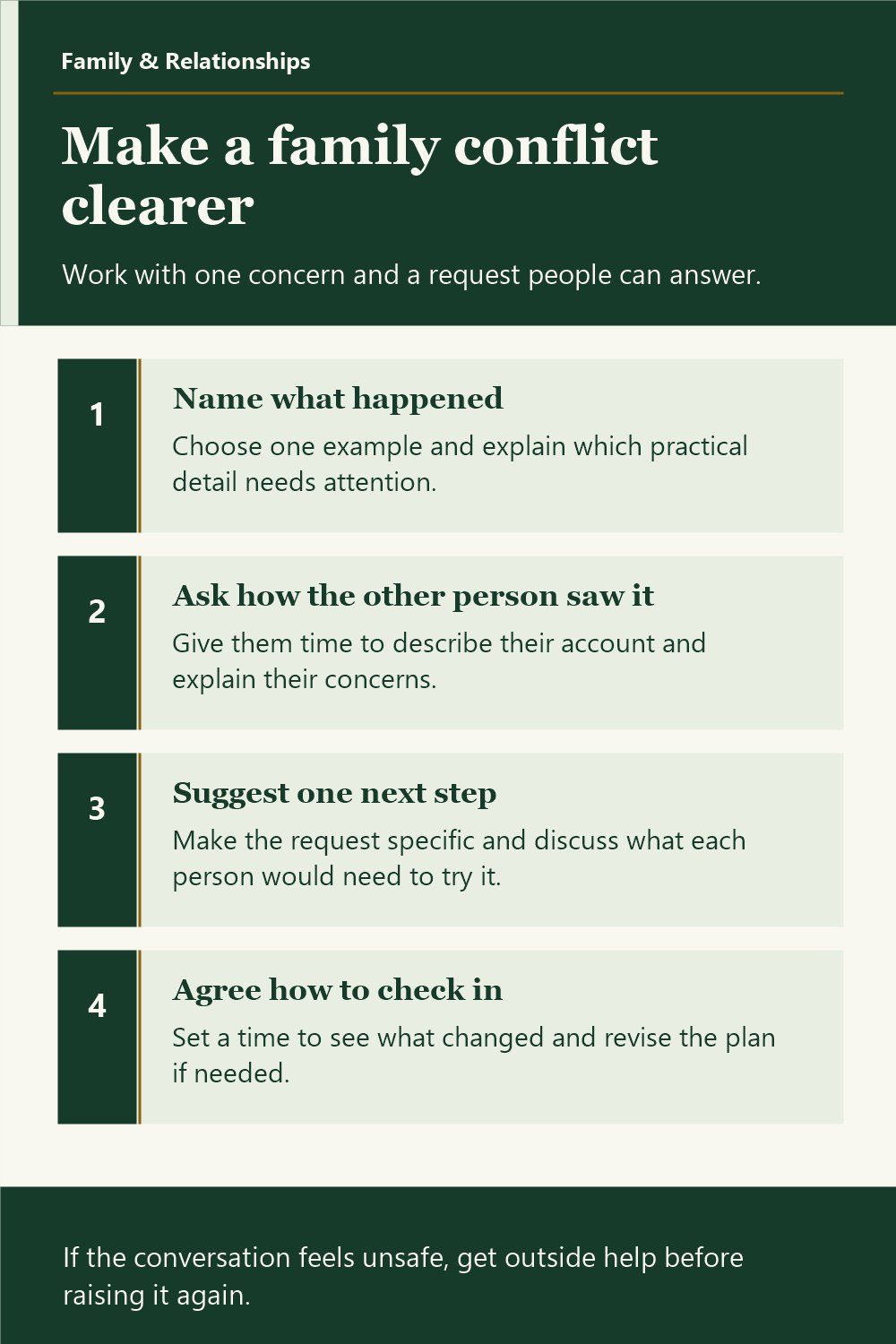
Make a family conflict clearer
Work with one concern and a request people can answer.
- Name what happened Choose one example and explain which practical detail needs attention.
- Ask how the other person saw it Give them time to describe their account and explain their concerns.
- Suggest one next step Make the request specific and discuss what each person would need to try it.
- Agree how to check in Set a time to see what changed and revise the plan if needed.
If the conversation feels unsafe, get outside help before raising it again.