

Wanting a relationship to work can sit alongside feeling hurt, tired or uncertain. Affection, history and attraction may matter to you, but they cannot tell you by themselves whether trying again is a workable choice.
These five patterns can help you consider what is happening now. They are questions for reflection, not a score that guarantees a future together. You can decide to pause or leave even when some hopeful signs are present.
1. You can make choices and raise concerns without fear
A useful starting point is whether each person can say no, disagree, ask for time and maintain contact with other people. Repair needs room for choice; it cannot depend on one person feeling trapped.
Notice what happens after you raise a concern. Are you heard, even when your partner disagrees? Or do you expect threats, punishment, surveillance or pressure to withdraw what you said?
Feeling insecure does not automatically prove that a partner is unsafe, and feeling close does not prove that everything is safe. Consider specific behavior and the effect it has on your freedom.
If you are afraid of someone’s reaction, seek private help from a trusted person or an appropriate support service. You do not have to begin a joint conversation or attempt reconciliation before considering your own safety.
2. Both people take responsibility for their part
One person can begin a conversation, but one person cannot supply both sides of a relationship. Look for voluntary effort from each of you rather than promises made only when an ending is mentioned.
Responsibility sounds specific: “I agreed to call and did not follow through. I understand that affected your plans.” It does not require agreeing about every detail, but it does require taking the other person’s experience seriously.
Acknowledging your own behavior does not mean accepting blame for someone else’s choices. You are not responsible for preventing another person from lying, intimidating you or violating an agreement.
Ask what each of you is willing and able to do differently. If all the work is assigned to one person, that is useful information about the limits of the current plan.
3. Promises are followed by changes you can observe
Choose a small number of problems and make the proposed changes concrete. For example, you might agree on a fairer division of household work, a clearer arrangement for shared spending or a way to give notice when plans change.
Decide when to check in and what would count as progress. A review should help you understand the pattern, rather than create a test that someone must pass to avoid punishment.
Changes can take practice, but repeated apologies without different behavior deserve attention. Notice whether a setback leads to honest discussion and an adjustment, or to denial and another demand that you be patient.
You can revise or end a plan that is not working. Agreeing to try again does not remove your right to reconsider.
4. Difficult conversations allow honesty and a pause
Repair often involves discussing disappointment, trust or expectations. You do not need identical opinions, but both people need a chance to explain their view without insults or deliberate humiliation.
Try discussing one event at a time, asking questions and checking what you understood. These ideas about honest communication may help you consider habits that make a conversation harder.
If a discussion becomes overwhelming, a pause with a clear plan to return can be useful. Repeatedly walking away without returning leaves the issue unresolved.
Consider whether it is becoming easier to name the real problem. Avoiding every difficult subject may feel calmer in the moment, while leaving important decisions untouched.
5. Closeness is freely chosen and practical needs are considered
Physical affection or sexual attraction can be meaningful, but neither obliges you to stay or proves that a relationship will recover. Each person can decline touch or sex, including during an attempt to reconnect.
Talk about the kinds of closeness you each want: time together, conversation, affection, shared activities or sexual contact. Differences need an honest discussion; they are not automatically solved by trying harder or adding novelty.
Consider everyday compatibility too. Plans about children, money, living arrangements and family responsibilities can affect whether the future you each want is workable.
You do not have to make a permanent decision today. Choose a next step you can freely accept, and pay attention to whether it brings more clarity, respect and room for both people’s needs.
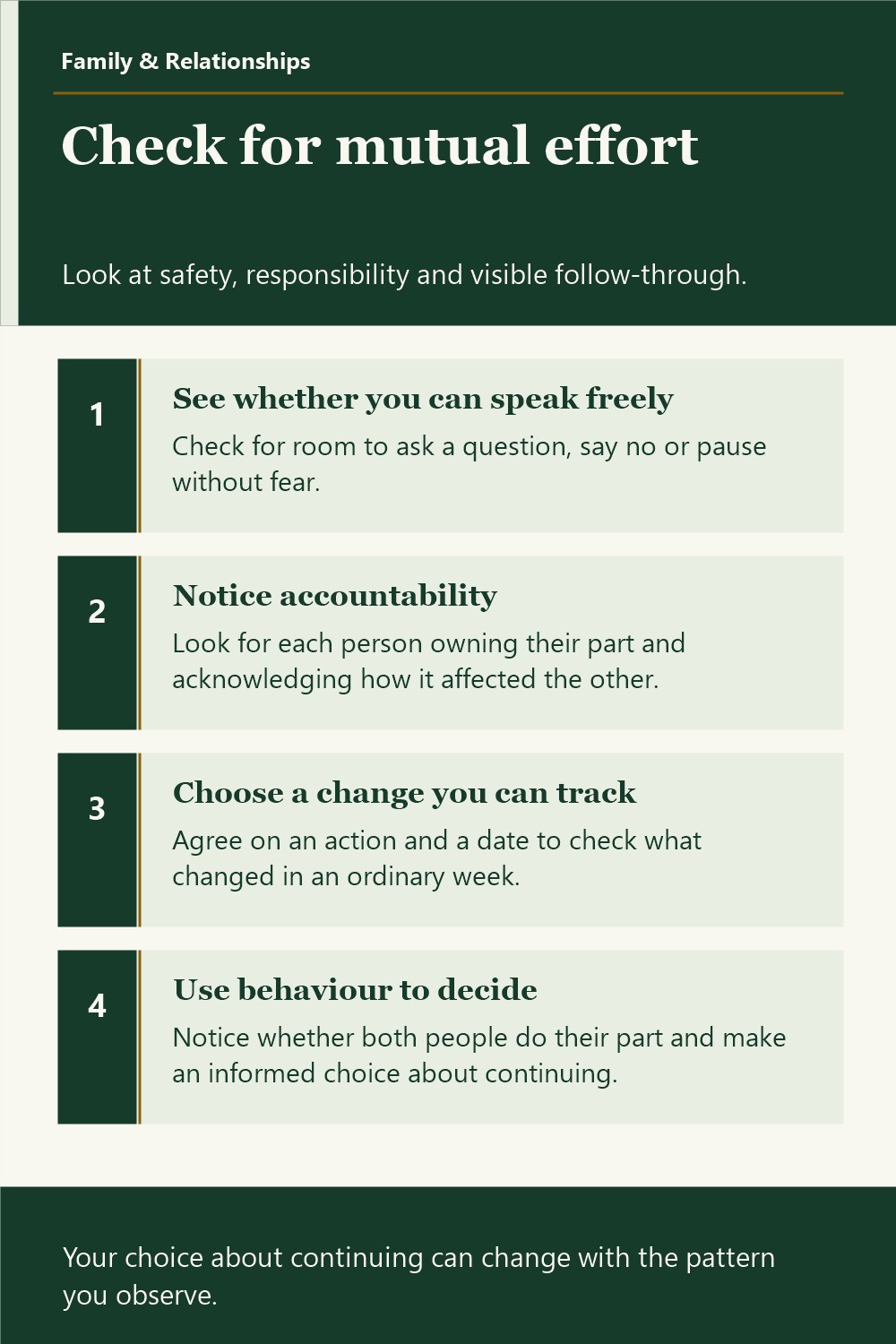
Read the infographic in text
Check for mutual effort
Look at safety, responsibility and visible follow-through.
- See whether you can speak freely Check for room to ask a question, say no or pause without fear.
- Notice accountability Look for each person owning their part and acknowledging how it affected the other.
- Choose a change you can track Agree on an action and a date to check what changed in an ordinary week.
- Use behaviour to decide Notice whether both people do their part and make an informed choice about continuing.
Your choice about continuing can change with the pattern you observe.