

You can feel strongly drawn to someone and still be unsure whether you want the relationship you have with them. Sexual attraction, affection, memories and the wish for closeness may all matter. None of those feelings takes away your right to choose what happens next.
Here, feeling bound describes the difficulty of stepping back from a connection, rather than a requirement to stay. You can take the feelings seriously while asking whether the arrangement allows honesty, consent and room for your own life.
In this article
1. Describe what draws you back
Try to name the experience without calling yourself weak, damaged or unable to be alone. You may miss physical closeness, enjoy the person’s company, hope for a different relationship or find familiar contact comforting. More than one explanation can fit.
Think about what happens before and after you meet or speak. Perhaps you enjoy the time together but feel unsettled when plans remain unclear. Perhaps a late message interrupts a decision to take space. A specific observation gives you something you can address.
You do not need to establish a hidden bond, diagnose an attachment style or decide what the other person secretly feels before making a choice. You can start with what they have said, what they do and how the arrangement fits your needs.
Missing someone is a feeling you can acknowledge. It does not require an immediate message, another meeting or a promise to continue the relationship. Give yourself time to decide whether an action would serve what you want.
2. Discuss the relationship beyond chemistry
Strong attraction does not settle practical questions about commitment, exclusivity, communication or a shared future. Those questions need their own conversation. Two people can enjoy intimacy and want different arrangements.
If your feelings have changed, say so plainly: “I have enjoyed being close to you, and I now want a committed relationship. Is that something you want too?” You can ask for clarity without presenting your preference as an obligation the other person must accept.
Listen to the answer that is available now. If they say they want something casual, consider whether that works for you. Continuing in the hope that more intimacy will change their mind may leave the original disagreement unresolved.
You can also want less contact or a slower pace. For example: “I want to spend more time getting to know each other before continuing this part of the relationship.” Discuss what that means in practice rather than assuming both people understand a phrase such as “taking it slowly.”
If your preferences do not match, you may need to change the arrangement or step away. Neither attraction nor time already spent together creates a duty to accept a relationship you do not want.
3. Keep consent a present choice
Consent needs to be freely given for the activity happening now, and it can be withdrawn. Past intimacy or a relationship label does not provide ongoing permission. You can change your mind.
RAINN’s guide to consent explains the importance of voluntary agreement without pressure, manipulation or fear. Silence and lack of resistance do not establish consent. Ask, listen and stop when a person withdraws agreement or seems uncomfortable.
Repeated requests after a refusal, threats or treating intimacy as repayment put pressure on the choice. You do not owe sexual contact to keep someone’s attention.
Respect the other person’s limits too. Strong desire does not entitle anyone to another person’s time, body or private information. Respect a request for no contact.
If you have experienced coercion or unwanted sexual contact, responsibility belongs to the person who crossed that boundary. A sexual assault support service, including RAINN in the United States, can help you consider your options.
4. Choose limits that match what you need
A useful limit describes something you can decide or do. If late-night visits leave you wanting a relationship the other person has declined, you might stop those visits. If you want time to think, you might decline new plans while you consider your preference.
State the limit clearly when it is appropriate and safe to communicate: “This arrangement no longer works for me, so I will not be meeting in this way.” You do not have to debate whether your feelings are reasonable before deciding how you will participate.
Make the practical part manageable. You might mute optional notifications, stop asking friends for updates or arrange necessary exchanges separately from a conversation about the relationship. Shared work, parenting or other responsibilities may mean some contact remains necessary.
You may feel disappointed or tempted to return to the old arrangement. That does not mean the limit was wrong. Consider what support would help you follow the choice you made, and review it if your circumstances or preferences change.
If you fear threats, retaliation or controlling behaviour, seek individual help with a safety plan before changing contact. A general suggestion to end communication may not fit your situation.
5. Make room for meaning, support and change
You may understand intimacy through faith, spirituality or a sense of personal connection. Those meanings can be important to you. You can also decide what kind of contact you want now; feeling a spiritual connection does not require you to accept pressure or mistreatment.
Keep room for interests, friendships, rest and responsibilities that matter outside this connection. You do not need to become completely self-sufficient or stop wanting closeness. Support from other people can be part of a life you choose for yourself.
When reviewing the arrangement, consider whether you can speak honestly, decline contact and discuss differences without being pressured. Notice whether the other person’s actions respect what you have agreed. These questions give you more to work with than the intensity of attraction alone.
If you want help understanding a recurring pattern or making a difficult decision, a counsellor can offer a place to explore it. You can ask for support while keeping responsibility for your own choices, rather than expecting someone else to decide the relationship’s future.
You can appreciate what a connection meant, miss parts of it and still choose a different next step. Your feelings deserve care, and your choices deserve room.
Read the infographic in text
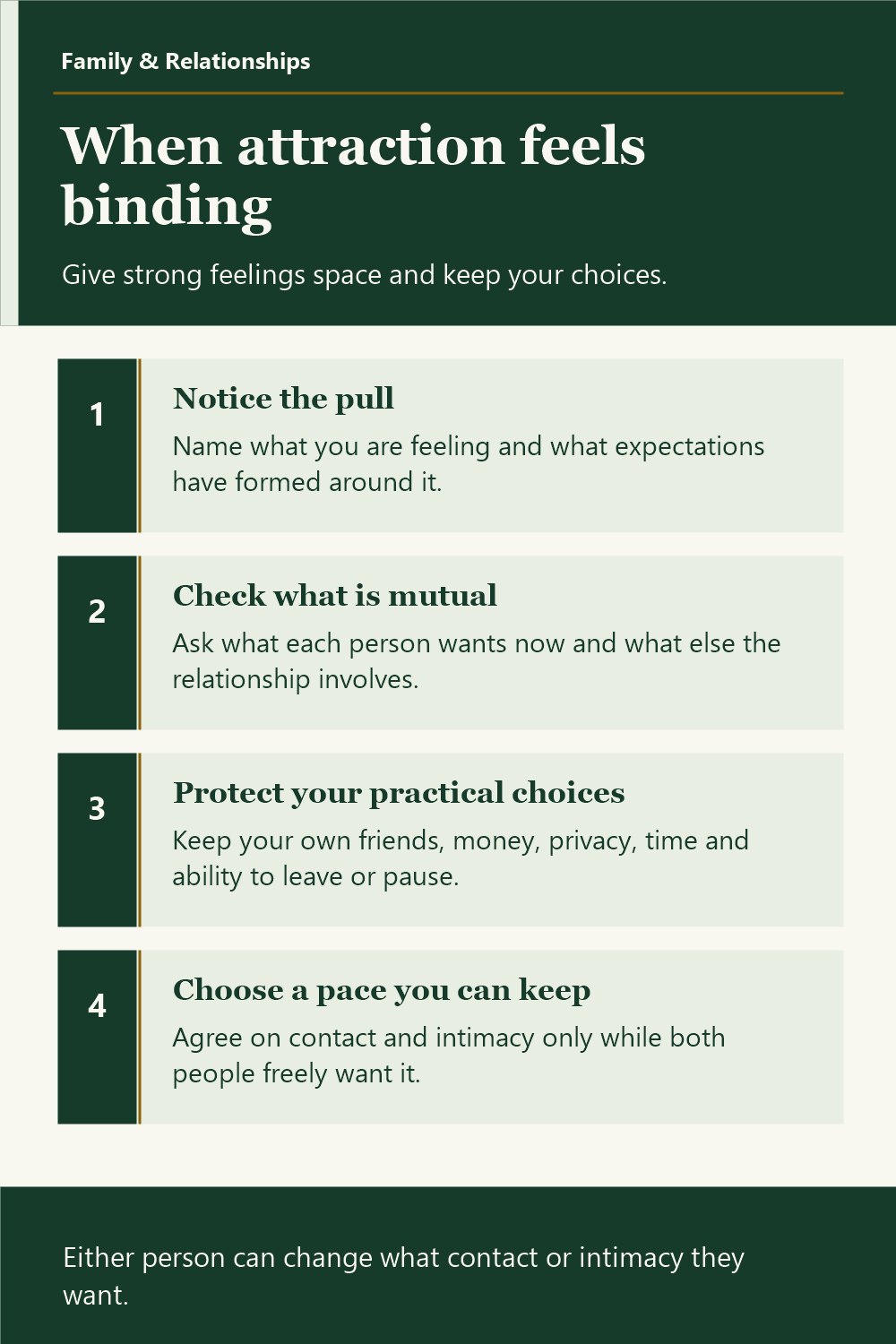
When attraction feels binding
Give strong feelings space and keep your choices.
- Notice the pull Name what you are feeling and what expectations have formed around it.
- Check what is mutual Ask what each person wants now and what else the relationship involves.
- Protect your practical choices Keep your own friends, money, privacy, time and ability to leave or pause.
- Choose a pace you can keep Agree on contact and intimacy only while both people freely want it.
Either person can change what contact or intimacy they want.