

When you care about someone who seems emotionally distant, it is easy to keep searching for the approach that will make the relationship work. You may wonder whether more patience, fewer questions or enough reassurance will finally lead to commitment. You can offer care, but you cannot create someone else’s readiness or make them fall in love.
Your needs belong in this relationship too. Wanting clarity, dependable contact or a shared future does not make you unreasonable. The useful question is what each of you is willing and able to offer now, and whether that relationship works for both of you.
On this page
Describe the distance without diagnosing him
“Emotionally unavailable” is a description people use in different ways, not a diagnosis you can establish from dating behaviour. You might mean that he avoids discussing feelings, wants a casual connection, repeatedly cancels plans or does not want the future you want. Those situations need different conversations.
Someone can need a slower pace and still show consideration. For example, he might explain that a difficult conversation is overwhelming, ask for a pause and agree when to return. Repeatedly disappearing and expecting you never to ask about it is a different arrangement. Describe the actual pattern rather than guessing at childhood experiences or hidden fears.
Trust can grow through honesty and reliability on both sides. It does not require you to accept indefinite uncertainty, prove that you will never leave or become responsible for managing all of his feelings.
Ask directly about the relationship you want
Choose a time when you can talk privately and neither person is rushing. Use a specific example and a clear request: “I enjoy being with you. I want a committed relationship, and I need to know whether that is something you want with me.”
You are allowed to discuss the future. Ask what commitment means to each of you: exclusivity, regular time together, emotional support or a longer-term plan. A relationship label is useful only if you understand the agreement beneath it. Do not assume either a label or affectionate behaviour answers every question.
Give him room to answer freely. Repeatedly arguing with a clear no is pressure; stating your own needs and deciding whether to continue is not. “I am not sure” may be honest, but it still leaves you with a decision about the relationship presently available.
Look for chosen effort, not potential alone
People can change what they do, but change has to include their participation. A promise to open up someday is different from agreeing to a conversation and following through. Notice whether he takes responsibility, asks about your experience and contributes without requiring you to organise every attempt.
Affection, attraction or a vulnerable conversation can show that a moment matters. They cannot establish a future commitment. If his words and actions leave you confused, ask about the inconsistency instead of searching for secret signs that he loves you.
If both of you want to continue, choose one or two practical agreements. That might mean planning the next date together or returning to an unfinished conversation on Sunday. Agree on something you both choose; do not set a test, withdraw affection to provoke pursuit or treat his history as a puzzle you must solve.
Decide what waiting would mean for you
Patience is an option, not an obligation. Consider what you would be accepting while you wait. Are you repeatedly hurt by cancelled plans? Are you postponing important choices? Are you freely enjoying the relationship as it is, or staying mainly for the person you hope he becomes?
You can name your limit without making a threat: “I understand that you do not want commitment. I do, so I am going to step back from dating.” If you choose a later check-in, make it a genuine time to reassess together, not a countdown that guarantees his feelings will change.
Choose support and your next step
You can care about someone and decide that the relationship is unsuitable. Talk with a trusted person who can listen without shaming you or insisting on one answer. Keep room for your friendships, daily responsibilities and interests while you decide.
If distance includes humiliation, threats, isolation or control, treating it as a commitment problem may miss what is happening. The National Domestic Violence Hotline describes patterns of emotional abuse and offers support. If you fear his reaction, seek individual safety support before arranging a confrontation. His choices are his responsibility; you do not have to earn care by becoming easier to neglect.
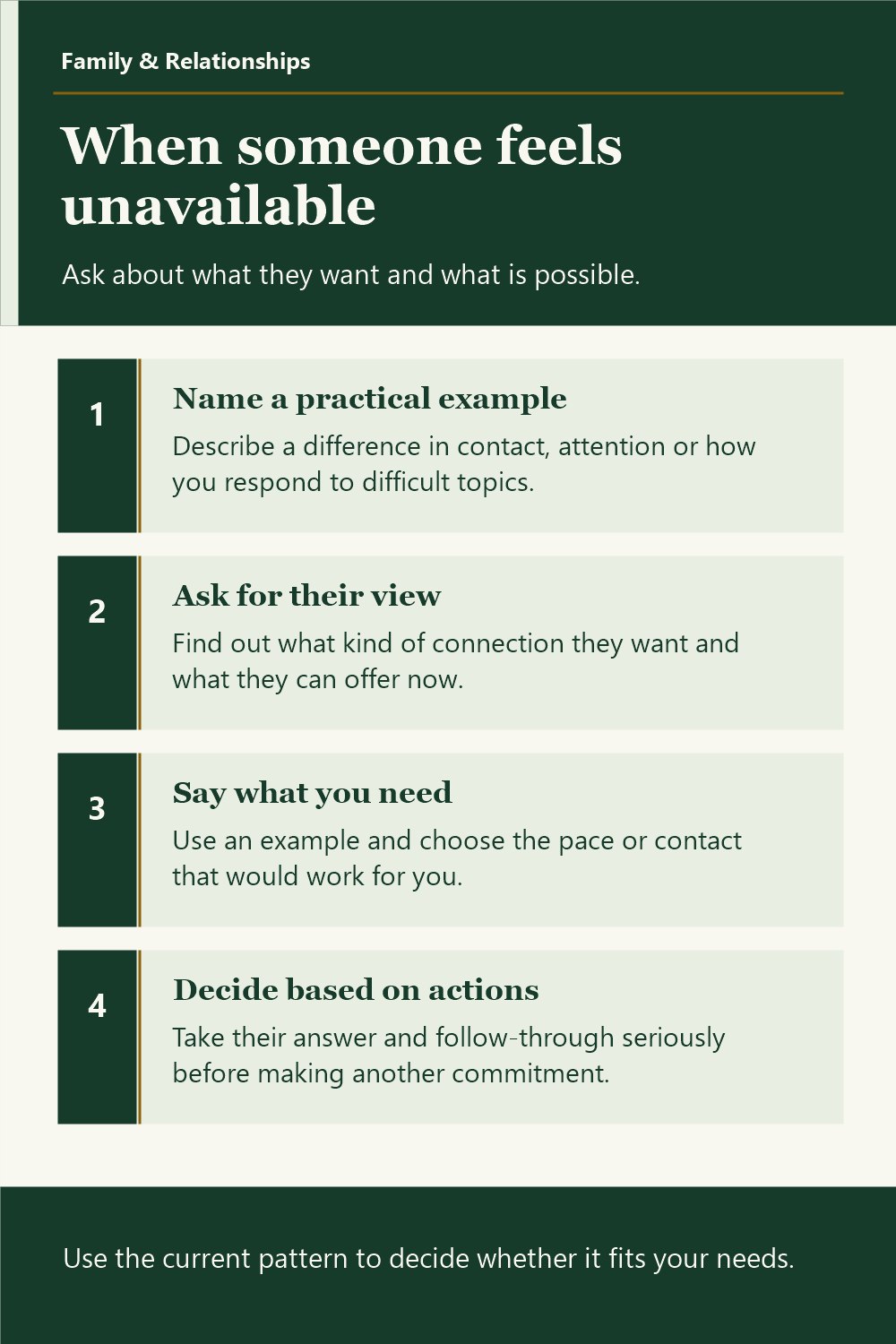
Read the infographic in text
When someone feels unavailable
Ask about what they want and what is possible.
- Name a practical example Describe a difference in contact, attention or how you respond to difficult topics.
- Ask for their view Find out what kind of connection they want and what they can offer now.
- Say what you need Use an example and choose the pace or contact that would work for you.
- Decide based on actions Take their answer and follow-through seriously before making another commitment.
Use the current pattern to decide whether it fits your needs.