

A close friendship can offer shared jokes, familiar routines and someone you enjoy turning to. It does not require perfect understanding, constant availability or a promise that nothing will ever change. You can care for the friendship by talking about expectations, respecting privacy and making room for each person’s life. The question is less whether you are flawless best friends and more whether the relationship leaves space for both of you.
In this article
Let closeness include clear communication
Knowing someone well may help you notice a familiar expression or remember what they usually prefer. It does not mean you can reliably know what they are thinking. Ask rather than using closeness as a reason to assume.
You could say, “You seemed quieter than usual. Would you like to talk, or would you prefer some space?” Either answer can be valid. Your friend does not need to disclose something before they are ready to prove that they trust you.
You might think of a close friend as a soul partner or chosen family. That language can express what the relationship means to you. It does not establish an obligation to agree, share every secret or remain available throughout your lives.
Make expectations workable
Talk about the practical parts of keeping in touch. A new job, disability, parenting responsibilities, distance or a difficult period can change how often you meet. Ask what is manageable now instead of comparing every week with an earlier stage of the friendship.
A specific invitation can help: “Would a short call on Sunday suit you?” If plans change, let each other know. Reliability can include communicating a cancellation and offering a realistic alternative; it does not mean never having to cancel.
Discuss recurring problems directly. If you often feel left waiting, explain the effect and ask for a clearer arrangement. You can decide how much planning effort to give without keeping a permanent score of who sent the last message.
Leave room for other friends and relationships. Being important to someone does not create a right to control who they see or demand priority over every other part of life.
Offer support without taking over
Ask what would be useful before assuming that the person wants advice. They may want someone to listen, company during an ordinary task or help thinking through options. You can offer one of these without taking responsibility for solving everything.
Keep private information private. Do not share screenshots, contact someone on your friend’s behalf or make a surprise arrangement unless they have agreed. Supporting a crush does not justify following, monitoring or invading another person’s privacy. Humiliating pranks are not a requirement of a playful friendship.
Encouragement should leave your friend room to choose their own goals and pace. Ask whether they want a reminder or help with a task rather than calling them lazy or scolding them into action. Resting or changing a plan can be a reasonable choice.
You also have limits. You might say, “I can listen for a little while tonight, but I cannot stay on the phone all evening.” The NHS guidance on healthy relationships includes considering what support you can offer while looking after your own wellbeing.
Repair specific hurts and leave room for difference
Affection does not prevent misunderstandings or make hurtful behaviour harmless. If something has happened, describe the particular action and its effect. “I felt exposed when you repeated that story” is a clearer starting point than deciding the whole friendship was false.
If you caused harm, acknowledge it without using closeness as an excuse. Ask what would help where appropriate, change the behaviour and accept that the other person may need time. An apology cannot guarantee the same level of trust or contact afterwards.
You can be pleased for a friend and still notice envy, disappointment or a difference in circumstances. A feeling does not require a hurtful action. You might offer congratulations, take time to reflect privately and choose whether a particular concern needs a conversation.
Repeated intimidation, cruelty or privacy violations deserve more than a quick reconciliation. You do not need to keep accepting harm because the relationship has a long history.
Allow the friendship to change
Some friendships remain close for many years. Others become occasional, change shape or end. None of these possibilities can be settled with a guarantee of forever.
Consider what contact you both want now. You might adjust expectations, make a new routine or step back from an arrangement that repeatedly leaves you hurt. Give an honest answer about what you can offer rather than promising a level of closeness you do not want.
You can value what the friendship has meant while taking its present reality seriously. Care includes shared enjoyment and support, as well as room for limits, other relationships and change.
Read the infographic in text
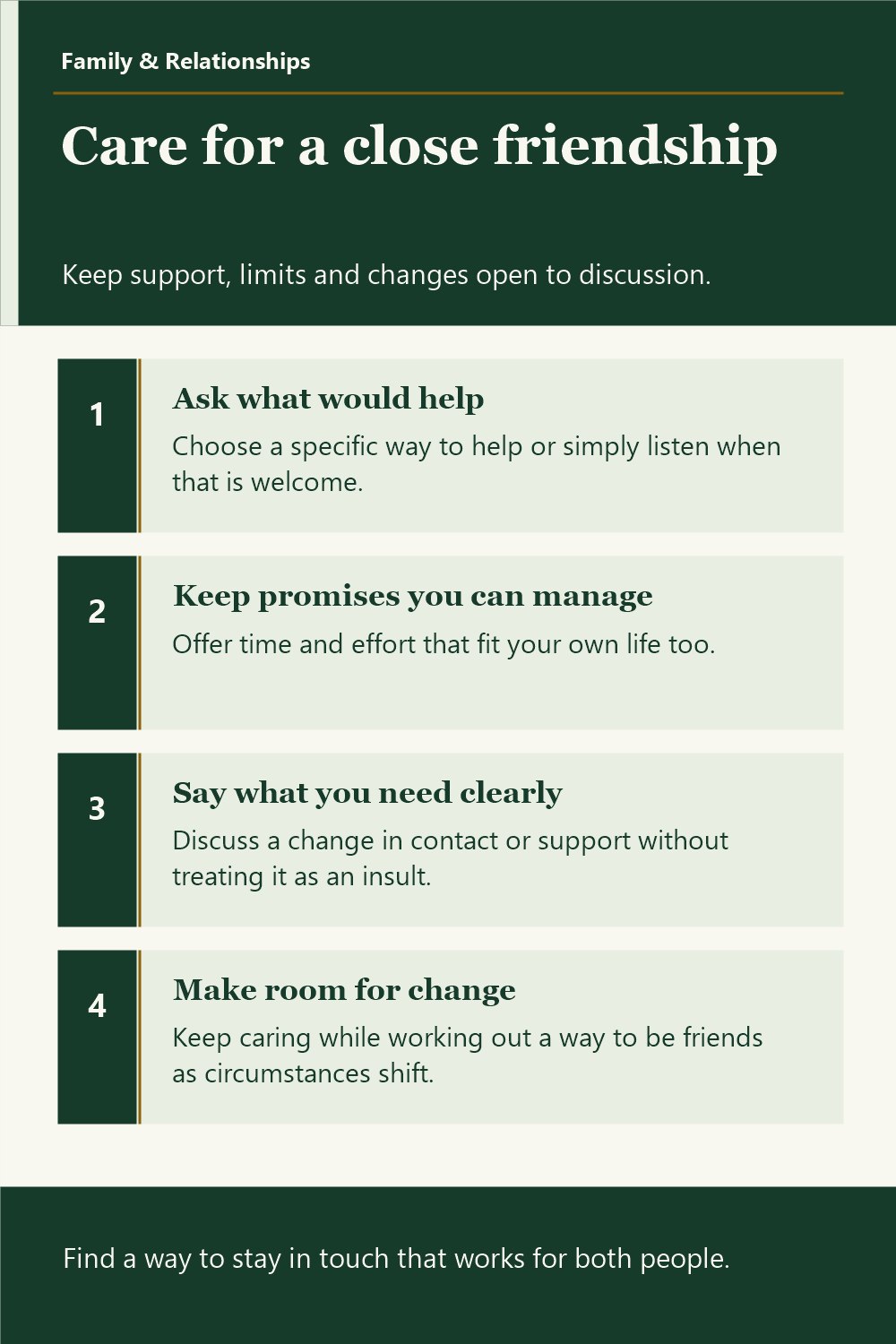
Care for a close friendship
Keep support, limits and changes open to discussion.
- Ask what would help Choose a specific way to help or simply listen when that is welcome.
- Keep promises you can manage Offer time and effort that fit your own life too.
- Say what you need clearly Discuss a change in contact or support without treating it as an insult.
- Make room for change Keep caring while working out a way to be friends as circumstances shift.
Find a way to stay in touch that works for both people.