

Missing an ex who broke your trust can leave you pulled in different directions. You may want another chance while also feeling angry, wary or relieved that the relationship ended. Those feelings can exist together. They do not tell you that you must reunite, and they do not make the betrayal your fault.
You cannot bring someone back through a reliable technique. Reconciliation requires both people to want a relationship and to address what happened. Before contacting an ex, consider what you are hoping for, whether contact is welcome and what would make a renewed relationship acceptable to you.
On this page
1. Clarify what happened and what you want now
Start with the relationship agreement you had. What commitments did you understand each other to have made, and what was broken? Attraction, a friendship and a breach of an agreed sexual or romantic boundary are not automatically the same thing. If the facts are uncertain, distinguish what you know from what you suspect.
Then ask what you miss. It might be affection, everyday company, shared plans or the stability of a familiar home. These are meaningful losses, but wanting relief from a loss is different from wanting the relationship as it actually was. Write down both the things you valued and the problems you would need to address.
Anger does not prove that you never loved the person. Nor does affection prove that getting back together would be right for you. You can care about an ex and still decide that trust, compatibility or the current circumstances do not support another relationship.
2. Respect contact limits
If your ex has asked for no contact, respect that request. Do not track their movements, arrange repeated “accidental” meetings, use new accounts or recruit friends to get around a boundary. You do not need to compete with another person or make your ex jealous to establish that your feelings matter.
If contact is welcome, there are no safety concerns and you want to ask about a conversation, a brief message can be enough: “Would you be open to talking about whether reconciliation is something we both want? It is okay to say no.” Ask once, leave room for an answer and do not turn silence into permission to keep pursuing.
Where children, property or other responsibilities require communication, keep that channel available for its practical purpose. A discussion about a collection time does not establish romantic interest. You can agree on a clear way to handle necessary arrangements while leaving the relationship question separate.
3. Consider accountability before promises
If you both want to explore reconciliation, discuss the breach directly. What does each person understand happened? Can the person who broke the agreement acknowledge their choice without blaming your appearance, availability or mood? You can consider problems in the relationship without accepting responsibility for someone else’s decision to deceive you.
Ask what a renewed agreement would involve. That might include clarifying exclusivity, discussing contact with other people and agreeing how to raise concerns. Each agreement must be voluntary. Access to every password, constant location checks or permanent surveillance is not a substitute for deciding whether you can live comfortably in the relationship.
The love is respect guidance on emotional boundaries explains that trust develops through consistent actions and cannot simply be demanded as proof of love. You do not owe immediate trust because your ex apologised, and they do not owe a reunion because you still love them. Both people can decide whether the proposed relationship fits.
4. Include practical needs in your decision
Money, childcare, housing, disability support and shared responsibilities are real considerations. Needing support does not make your feelings shallow or disqualify you from making a thoughtful decision. Try listing the practical issues separately so that a reunion is not treated as the only possible answer to every problem.
For example, you might need a workable parenting schedule regardless of whether you date again. You may want help understanding a lease, shared account or financial arrangement. Seek qualified local advice for legal or financial questions rather than relying on a romantic promise to settle them.
If the relationship involved threats, coercion or fear, prioritise individual safety support before planning a meeting or joint counselling. You do not have to meet alone or explain your decision in person. A domestic abuse service can discuss options suited to your location and circumstances; immediate danger calls for local emergency help when it is safe to seek it.
5. Choose a next step without a reunion deadline
Your options can include declining a reunion, asking for more time or having one mutually agreed conversation. If you try again, discuss what each person is agreeing to now and when you want to review how it is going. A review is an opportunity to speak honestly, not a date by which forgiveness must be complete.
Keep some support outside the relationship. You could ask a friend to listen without pushing you toward either outcome, or speak individually with a qualified counsellor about your choices. You can change your mind if the arrangement does not work for you.
A useful immediate question is: “What information or support do I need before choosing?” You can answer that without chasing your ex or proving that your love is strong enough. The decision can take account of affection, respect, safety and the practical life you want to build.
Read the infographic in text
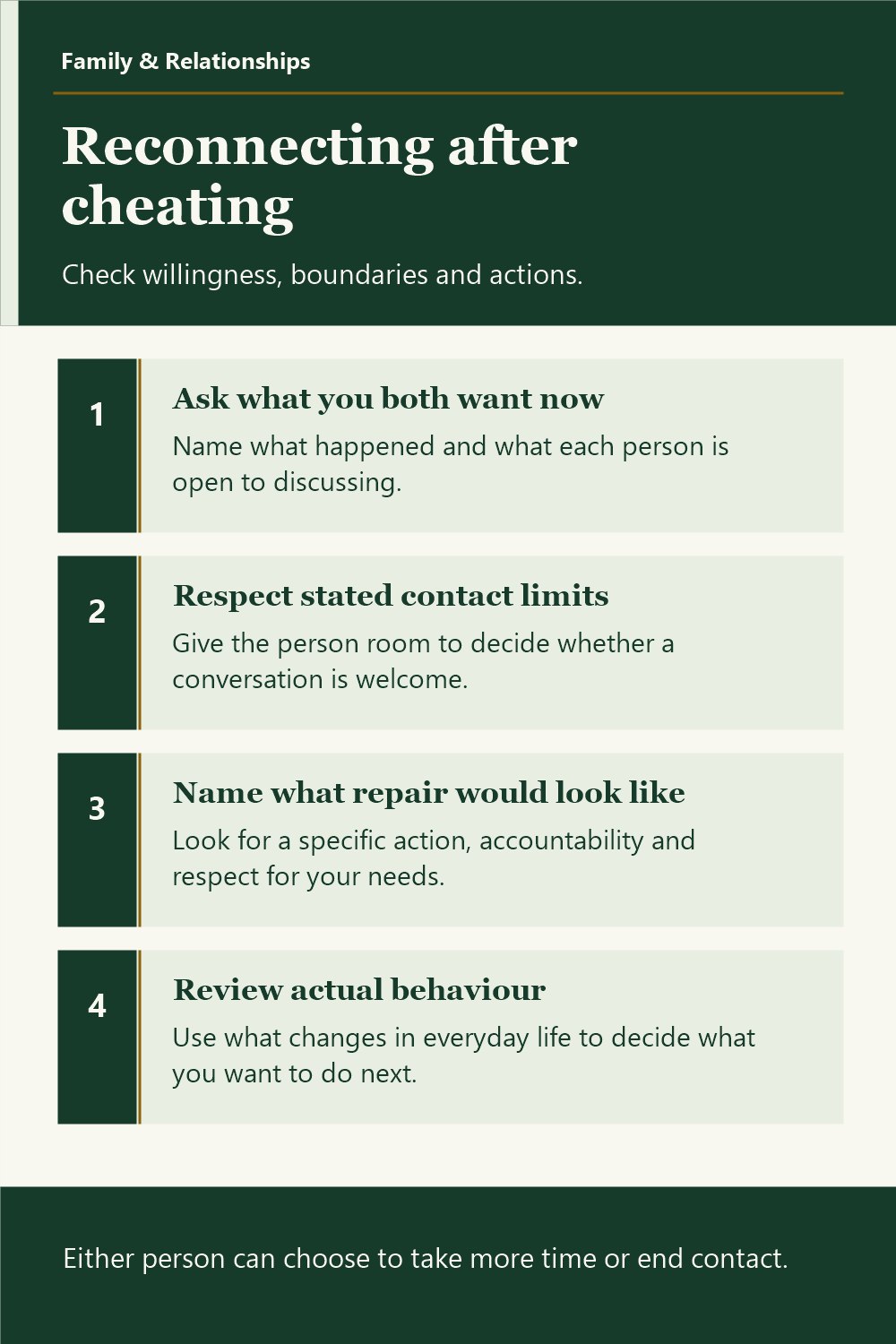
Reconnecting after cheating
Check willingness, boundaries and actions.
- Ask what you both want now Name what happened and what each person is open to discussing.
- Respect stated contact limits Give the person room to decide whether a conversation is welcome.
- Name what repair would look like Look for a specific action, accountability and respect for your needs.
- Review actual behaviour Use what changes in everyday life to decide what you want to do next.
Either person can choose to take more time or end contact.