

Being straightforward in dating means making your intentions and limits understandable while leaving room for the other person’s choice. You can be warm, uncertain or nervous and still communicate clearly.
Start with one specific message. Say what you would like, ask rather than assume, and give the other person space to answer. Clear wording helps you understand each other; it cannot guarantee agreement.

1. Make an invitation someone can answer
You do not need a rule about waiting a set number of days before showing interest. A simple invitation gives more information than hoping the other person decodes a hint.
Try, “I enjoyed talking with you. Would you like to meet for coffee on Saturday afternoon?” Include enough detail to make the invitation useful without planning the other person’s entire weekend.
If a message or pickup line makes you uncomfortable, you can decline or stop responding. You do not owe someone a chance to persuade you, and you do not need to insult them to end the exchange.
2. Discuss contact instead of testing interest
People have different work patterns and preferences for texting, calls and voice messages. Ask what suits them before switching to repeated calls or expecting immediate replies.
If you forget to reply, acknowledge it simply: “I meant to answer earlier. I am still interested in meeting; are you free on Sunday?” An explanation can help, but your follow-through matters too.
If you feel pressure to play hard to get, consider whether that makes your actual intentions harder to understand. You can take your time without pretending to feel something different.
3. Keep digital conversations clear
Social media activity does not reliably tell you whether someone wants a relationship. A liked photo or an unanswered message is not a substitute for a direct conversation about plans.
Choose a channel that allows both people to respond comfortably. For a complicated subject, you can ask, “Would you prefer a call, or would it help if I wrote this down?”
Direct questions also cannot verify an online stranger’s identity by themselves. If stories and practical details do not add up, review signs of a possible catfishing situation and protect your personal information.
4. State a preference without controlling the answer
Be honest about the kind of date or connection you want: “I would enjoy a relaxed walk,” or “I am looking for a committed relationship.” Avoid implying agreement that has not been discussed.
You can choose a date without alcohol, leave early or suggest a different setting. Comfort and accessibility are useful things to discuss, not obstacles you need to hide.
An invitation leaves room for a no: “I would like you to come to my celebration, but I understand if you cannot.” Then decide what you will do with the answer.
A boundary describes what you are comfortable with; it does not give you control over someone else. Physical intimacy needs willing agreement, and either person can change their mind. Love is respect explains emotional, physical and digital boundaries.
5. Address a problem with care
Name the behavior and its effect: “When the plan changed and I did not hear from you, I waited for an hour. Please let me know if you need to cancel.” This is clearer than expecting someone to guess why you are upset.
Being open does not require sharing every private detail immediately or describing someone’s character harshly. You can say what matters without using insults, labels or a long list of past mistakes.
When a friend asks for advice, ask whether they want ideas or someone to listen. Offer your view without deciding their relationship for them. The same courtesy helps when you are the one asking for support.
6. Accept the answer and choose your next step
If someone declines a date or wants a different kind of relationship, take that answer seriously. Repeated persuasion can turn a clear conversation into pressure. You are also free to decide that uncertainty or repeated cancellations do not work for you.
Notice whether you can both ask questions, disagree and respect a limit. A person who mocks your needs or reacts with intimidation is giving you important information; better wording alone cannot make that situation safe.
You do not have to perform a blunt personality to be understood. A kind sentence, a specific request and consistent action are enough to begin. If friendship is part of the situation, consider these conversations before dating a friend.
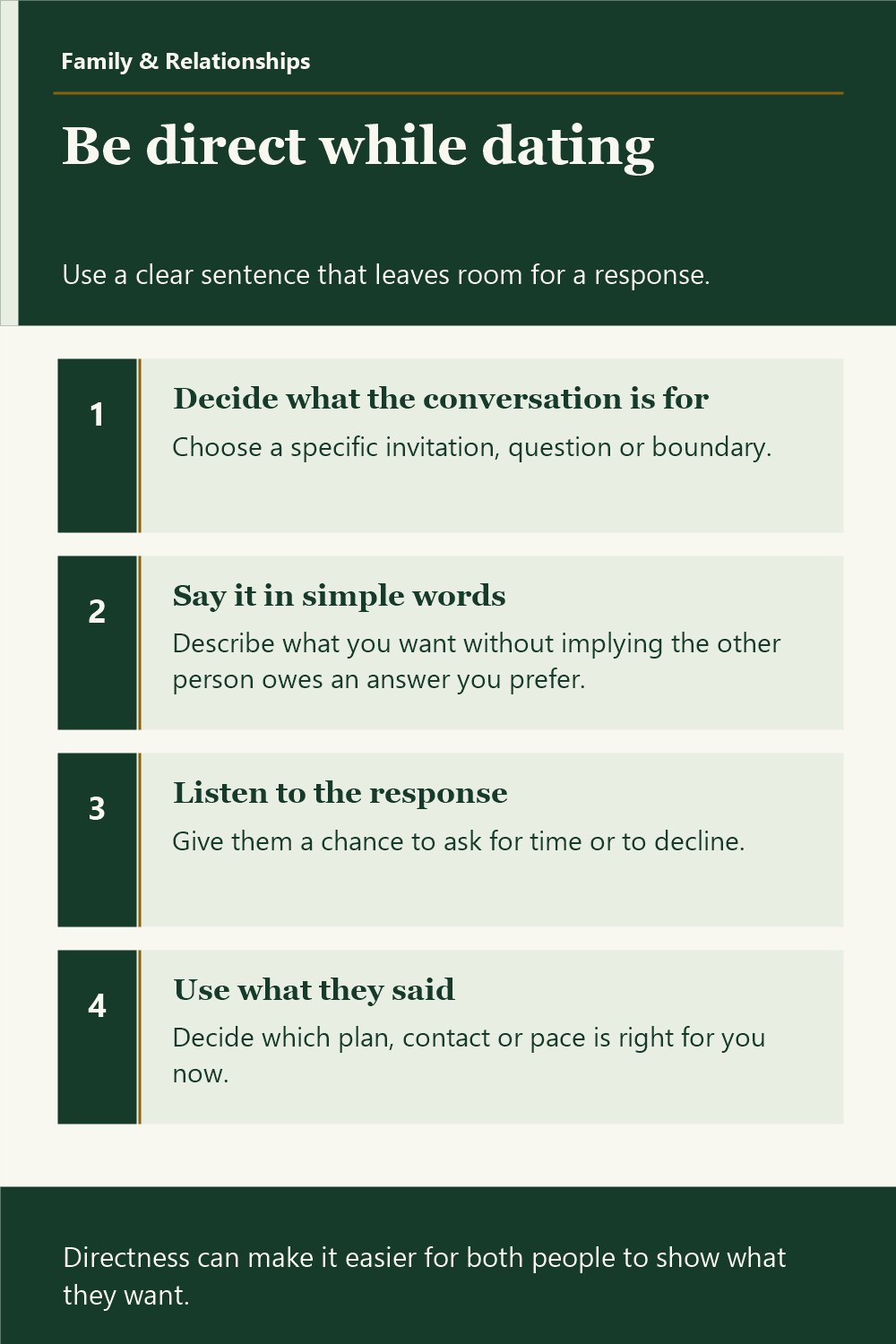
Read the infographic in text
Be direct while dating
Use a clear sentence that leaves room for a response.
- Decide what the conversation is for Choose a specific invitation, question or boundary.
- Say it in simple words Describe what you want without implying the other person owes an answer you prefer.
- Listen to the response Give them a chance to ask for time or to decline.
- Use what they said Decide which plan, contact or pace is right for you now.
Directness can make it easier for both people to show what they want.