

Catfishing involves someone presenting a false identity online. It can be upsetting to discover that a connection was not what you thought, and being deceived does not make you foolish.
You do not need to prove someone’s intentions before choosing to pause contact. These checks help you decide what to share and what questions to ask without treating someone’s job, appearance or preferred apps as proof of deception.
1. Separate a concern from a stereotype
Being unemployed, having a degree, avoiding a particular app or taking ordinary photographs does not establish whether a person is genuine. People have different circumstances and privacy preferences.
Instead, notice information that changes without explanation, requests that make you uncomfortable or pressure to ignore your own limits. Write down the specific issue you want to understand.
A feeling of unease is enough to slow down. It does not need to become a public accusation or a search for personal documents about the other person.
2. Check the story without giving away more of your own
Ask a straightforward question about an inconsistency and see whether the answer addresses it. Avoid filling gaps with the explanation you most hope is true.
The FTC’s guidance on romance scams includes reverse-image searching a profile photo to look for mismatched names or details. A mismatch deserves attention; finding no match does not verify someone’s identity.
Do not send your own identity documents, home address, banking details, passwords or verification codes to make a new match trust you. You can decline a request without offering an alternative private detail.
3. Notice how they respond to your pace and boundaries
Someone may have a genuine reason to prefer messaging or postpone a call. The question is also whether they can discuss a comfortable way to get acquainted without pressuring you.
You might say, “I would prefer to stay on this app while we get to know each other.” If they demand secrecy, become threatening or insist you must act immediately to prove your feelings, step back.
A phone or video conversation can help you get acquainted, but it is not a guarantee of honesty. You can end contact if the available information or the pressure does not feel acceptable to you.
4. Keep money out of an online-only relationship
Requests for emergency payments, travel costs, gift-card codes or cryptocurrency deserve a firm pause. Do not send money or gifts to a romantic contact you have only met online.
Be especially cautious about someone offering to manage an investment or move money for you. Affection, frequent messages and an impressive profile do not make a payment request safe.
The FTC describes how romance scammers build trust before asking for money and may direct people toward payment methods that are difficult to recover. Keep financial decisions separate from pressure within the conversation.
5. Choose contact and meeting plans you control
If both people want to meet, discuss a public place and an arrangement you can comfortably leave. Use transport you control and let a trusted person know your plans.
You do not have to meet privately, change your destination at the last minute or depend on a new contact for a way home. If plans keep changing, you can postpone or decline.
For a broader starting point, see practical steps for a comfortable start with online dating. Precautions give you options; they cannot guarantee another person’s behavior.
6. Act promptly if you have already shared money or access
If you suspect a scam, stop sending money and preserve relevant messages, payment details and receipts. Contact the bank, card issuer or payment provider through its official app, website or known telephone number.
Ask what can be done to stop or recover the payment. Recovery is not guaranteed. The FTC’s steps after a scam cover different payment methods and compromised personal information.
If you shared an account password, change it through the genuine service, change it anywhere else you reused it and enable two-factor authentication. Use the service’s account-recovery process if you cannot sign in.
Report the account to the dating or social platform. In the United States you can also report suspected fraud through ReportFraud.ftc.gov; elsewhere, use your local consumer-protection or fraud-reporting service. Ask someone you trust for support while you work through the next steps.
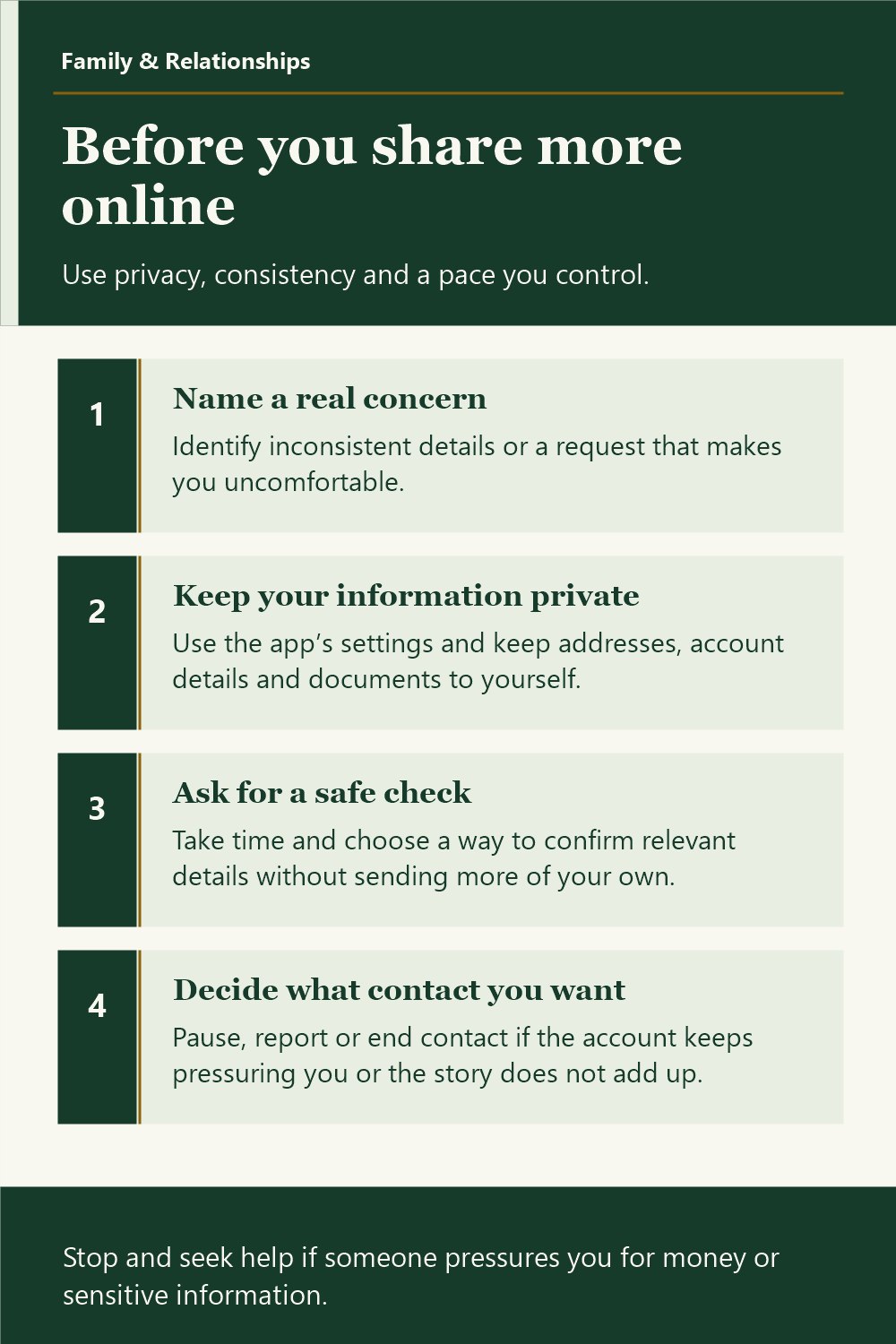
Read the infographic in text
Before you share more online
Use privacy, consistency and a pace you control.
- Name a real concern Identify inconsistent details or a request that makes you uncomfortable.
- Keep your information private Use the app’s settings and keep addresses, account details and documents to yourself.
- Ask for a safe check Take time and choose a way to confirm relevant details without sending more of your own.
- Decide what contact you want Pause, report or end contact if the account keeps pressuring you or the story does not add up.
Stop and seek help if someone pressures you for money or sensitive information.