

A recurring disagreement deserves attention when it leaves you afraid to say no, cut off from other people or unable to make ordinary choices. Looking at specific behavior can help you describe what is happening, even if you are uncertain about the relationship as a whole.
You do not have to prove a label or wait for several warning signs before asking for support. If you are in immediate danger, contact local emergency services when it is safe to do so.
1. Notice what happens when you express a different need
Can you disagree, decline touch, spend time alone or keep some things private without being threatened or punished? Love is respect’s guidance on boundaries explains how personal limits relate to your needs and choices.
A useful question is: “Am I agreeing because I want to, or because I am afraid of what will happen if I do not?” Your answer may help you identify a concern to discuss privately with someone you trust.
Being close to someone does not remove your right to change your mind. You do not owe access to your body, accounts or time as proof that you care.
2. Pay attention to restrictions on contact and everyday life
A partner may discourage contact with friends or family, insist on deciding where you go, interfere with work or school, or control access to money for necessities. The National Domestic Violence Hotline includes these among its warning signs of abuse.
Consider whether your choices and support network have become smaller. You can seek another person’s perspective without first persuading your partner that your concern is reasonable.
3. Take intimidation and pressure seriously
Threats, damage to belongings, sexual pressure and threats involving children or pets are reasons to seek help. Affectionate periods do not cancel out these behaviors.
You are not responsible for preventing another person’s harmful choices by finding exactly the right words. If you fear a reaction, a private conversation with a support service may be a more useful next step than confronting your partner alone.
4. Notice a pattern of dismissing or denying your experience
Gaslighting can involve repeated denial, trivializing your concerns or challenging your memory in ways that undermine your trust in yourself. The Hotline explains these patterns in its guide to what gaslighting can look like.
A difference in recollection can happen in any relationship. Consider the broader pattern: can you discuss an event openly, or does every concern become another reason to dismiss you?
You can describe what happened and how it affected you without reaching a diagnosis or proving someone’s intentions. A trusted person or specialist service can help you think through what you are experiencing.
5. Consider private support and a plan that fits your situation
A safety plan can be useful while you are staying, thinking about leaving or after a separation. The Hotline’s planning resource offers a starting point; an advocate can help you consider your circumstances and available options.
In the United States, the National Domestic Violence Hotline can be reached at 1-800-799-7233. Outside the United States, look for a local domestic abuse support service.
If you suspect your device or accounts are monitored, consider a safer way to contact support. Private browsing does not erase every trace of activity. The Hotline’s internet-safety guidance explains these limits.
You do not have to announce a decision or make a sudden confrontation in order to ask for help.
6. Support someone else without taking over their decisions
If you are worried about a friend, ask privately how they are doing and listen without blaming them. Ask what contact is safe and what practical help they would welcome.
The Hotline’s guidance on supporting a person experiencing abuse emphasizes respecting their decisions. Offer help without insisting that they act on your timetable.
Avoid sharing their location, private story or plans without permission. Continuing to be a steady, respectful contact can matter even when they are uncertain about what to do next.
Read the infographic in text
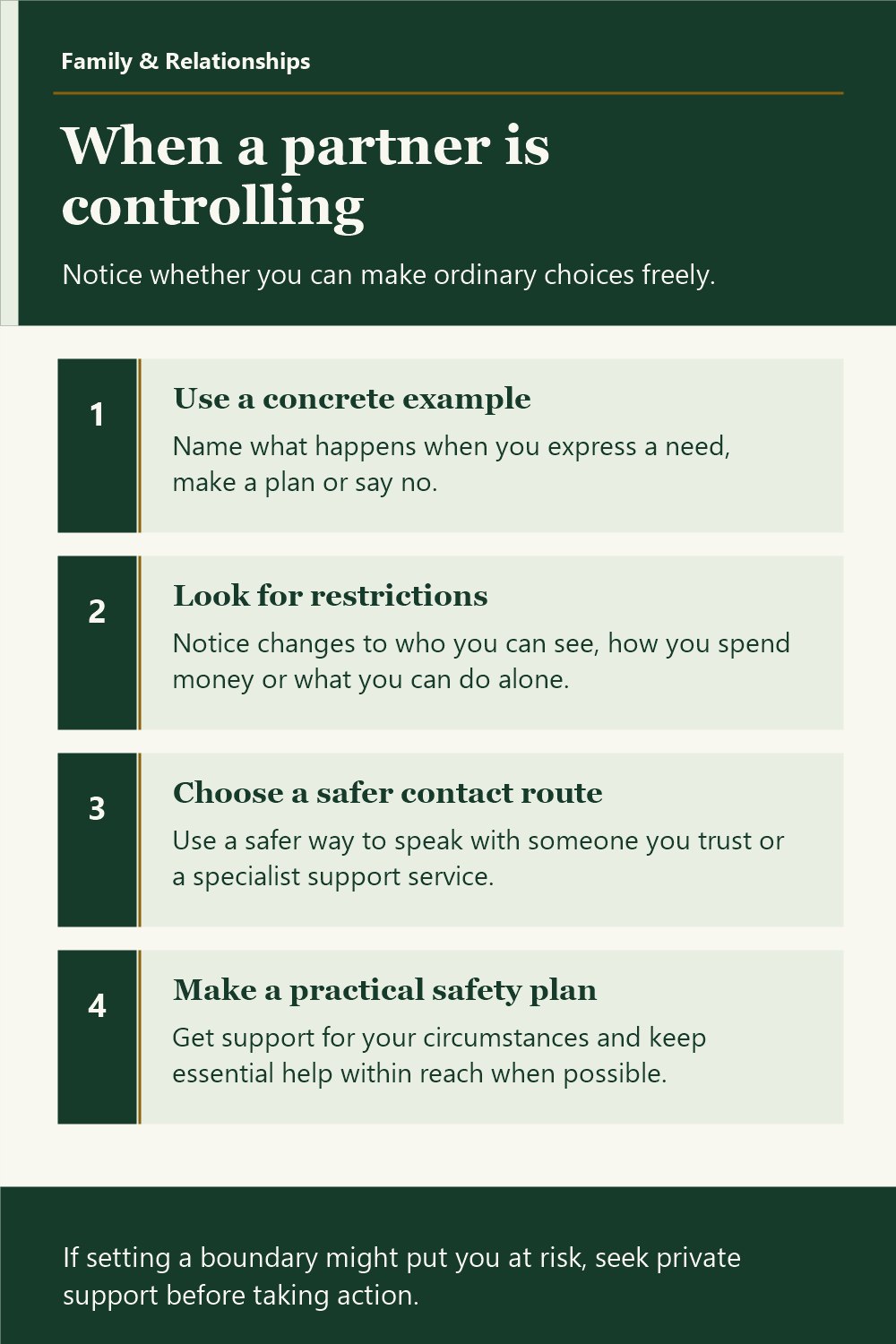
When a partner is controlling
Notice whether you can make ordinary choices freely.
- Use a concrete example Name what happens when you express a need, make a plan or say no.
- Look for restrictions Notice changes to who you can see, how you spend money or what you can do alone.
- Choose a safer contact route Use a safer way to speak with someone you trust or a specialist support service.
- Make a practical safety plan Get support for your circumstances and keep essential help within reach when possible.
If setting a boundary might put you at risk, seek private support before taking action.