

Conflict can happen in a relationship without meaning that every conversation must become a fight. A clearer discussion starts with one issue, a realistic time to talk and room for both people’s views. It also depends on whether speaking openly feels safe.
You can change how you express a need, but you cannot control another person’s reaction or do their share of the work. The steps below can help you prepare a conversation and assess what happens afterward.
On this page
1. Check whether a conversation feels safe
Ordinary disagreement allows both people to speak, say no and take a break. Threats, intimidation, coercion or fear of retaliation call for a different response. You do not have to find a gentler way to speak before you deserve safety.
If those patterns are present, consider individual support and a safety plan rather than relying on a joint discussion. The Hotline explains why joint counselling can be unsafe in an abusive relationship. A communication exercise is not a substitute for addressing control or harm.
2. Choose one issue and a workable time
Decide what you want to discuss before starting. “How can we share the evening chores?” is more manageable than trying to resolve every disappointment in the relationship at once.
Check whether you both have the time and capacity to talk. You might ask, “Could we spend fifteen minutes on this after dinner?” If now is a poor time, suggest another time instead of leaving the issue indefinitely unspoken.
Notice your own frustration or tiredness without treating emotion as a reason your needs do not count. You can be upset and still explain something clearly.
3. Describe the problem and make a specific request
Use a recent example and explain its impact: “I handled dinner and the washing up every night this week, and I’m worn out.” Then ask for an action you can both understand: “Could you take responsibility for dinner on Tuesdays and Thursdays?”
That gives you something concrete to discuss. It does not require avoiding every uncomfortable fact or accepting sole responsibility for the conflict. You can name hurtful behaviour directly.
Try to leave room for a different practical proposal. The aim is an agreement that addresses the need, rather than winning approval for the exact first solution you suggested.
4. Listen for what needs clarification
Let the other person explain their view, then check your understanding: “Are you saying the timing is difficult, or that you do not agree this should be shared?” Ask rather than assuming the motive behind their response.
You can acknowledge what they said without agreeing with everything. Being heard matters on both sides. Listening does not require tolerating insults, giving up a boundary or accepting a claim you know is inaccurate.
If you keep talking past each other, restate the one decision you are trying to make. Write down the options if that makes the conversation easier to follow.
5. Pause without turning it into punishment
If the conversation becomes too heated to continue usefully, suggest a break and, where safe and realistic, a time to return. “I need to stop for now. Can we try again tomorrow morning?” is clearer than disappearing and expecting the other person to guess.
A pause is not a way to force an apology or withhold ordinary necessary communication. Equally, no one has to stay in a conversation that is frightening or degrading. Consider what you need to remain safe.
When you return, begin with the unfinished issue rather than reopening the entire argument. If either person no longer wants the discussion, acknowledge that you may need a different way to address the situation.
6. Assess what happens after the conversation
Make the agreement specific: who will do what, when it starts and when you will review it. Notice whether it is followed, whether circumstances changed and whether both people can raise a concern about it.
A calm conversation does not guarantee shared values, changed behaviour or a lasting relationship. If the same problem continues, you may need different arrangements, suitable support or a decision about what you are willing to continue.
You cannot create mutual effort by communicating perfectly on your own. Use the conversation to learn what is possible and to decide your next step with clearer information.
Read the infographic in text
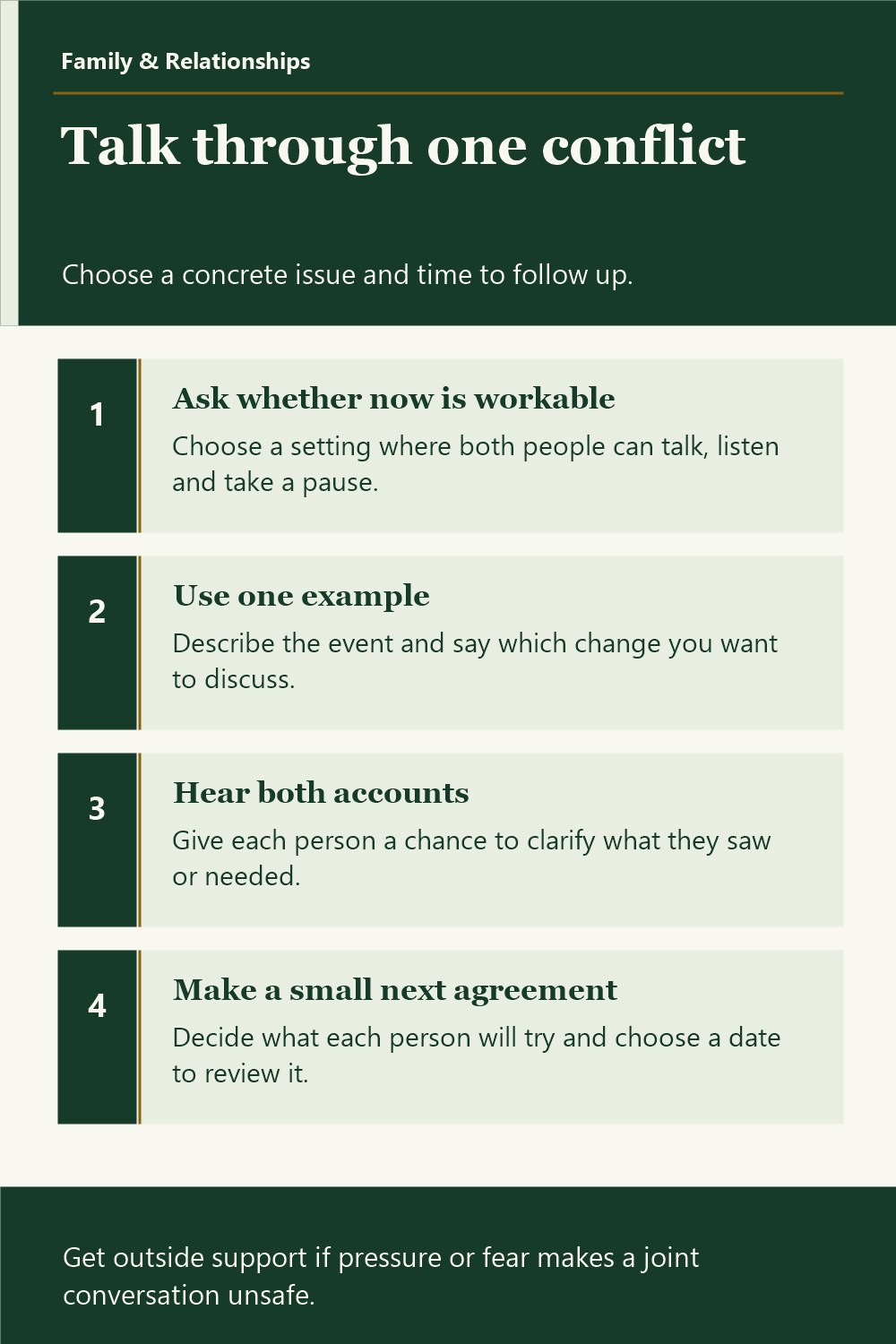
Talk through one conflict
Choose a concrete issue and time to follow up.
- Ask whether now is workable Choose a setting where both people can talk, listen and take a pause.
- Use one example Describe the event and say which change you want to discuss.
- Hear both accounts Give each person a chance to clarify what they saw or needed.
- Make a small next agreement Decide what each person will try and choose a date to review it.
Get outside support if pressure or fear makes a joint conversation unsafe.