

A long-distance relationship can involve affection, uncertainty, travel and practical limits at the same time. Wanting it to work does not remove those limits. Clear agreements can help you understand what each person can offer and whether the arrangement suits you both.
Start with the relationship you have now, including time zones, money, responsibilities and your own life where you live. You do not have to prove your love through constant contact or visits you cannot comfortably manage.
On this page
1. Discuss the relationship you both want
Clarify what being together means to each of you: exclusivity, the amount of contact you want and how the relationship fits your other commitments. Do not assume that distance changes an agreement without discussing it.
Talk about the future without turning a hope into a promise. Is living closer something you both want? What would need to happen first, and what remains uncertain? You can care about each other while recognising that your plans may differ.
2. Agree on contact that fits your actual schedules
Look at time zones, work, caring responsibilities and energy. Choose a realistic window for calls and how to handle cancellations. Constant availability is not the same as commitment, and a missed message alone does not establish what someone feels.
Mix the kinds of contact you both enjoy: a conversation, a short voice message, a photograph from your day or a postcard. Ask what feels connecting rather than setting a universal rule about how often couples should speak.
If a discussion becomes heated, agree when to return to it. You do not have to keep calling until every disagreement is resolved that night.
3. Talk about doubts without demanding surveillance
Separate what you know from what you fear. “Our last three calls were cancelled” gives you something specific to discuss. “You must be hiding something” assumes an explanation before you have heard one.
Ask for clarity about the pattern and what could change. Trust does not require ignoring inconsistencies, and reassurance does not require sharing passwords, constant location tracking or proof of every activity.
Each person should be able to maintain friendships and a private life. If contact becomes controlling or frightening, seek support rather than treating it as an unavoidable part of loving someone at a distance.
4. Plan visits within both people’s limits
Discuss travel costs, time off, accessibility, accommodation and who is doing the travelling. A visit is not automatically manageable simply because you miss each other. Avoid committing money or time that puts essential needs at risk.
Decide how much time together you both want and whether either person needs their own space. Agree on the plan before booking rather than assuming a surprise arrival will be welcome.
If you have not met in person, keep first-meeting safety separate from romantic expectations: choose a public place, retain your own way to leave and let someone you trust know the plan.
5. Make room for ordinary life as well as romance
Distance can make every visit feel like a special occasion. Where you both want to, include ordinary activities too: sharing a meal, discussing a practical decision or hearing about an uneventful day.
You do not need to perform constant happiness or make every call meaningful. Ask what kind of support is useful when one person is tired or having a difficult week, and be honest about what you can offer.
Keep activities and support beyond the relationship. Waiting for the next message should not have to organise your entire day.
6. Set a time to review the arrangement
Check in about whether the contact, travel and future plans are working for both of you. A review can be a chance to change an agreement, recognise a new limit or acknowledge that the relationship no longer fits.
Effort alone cannot guarantee that distance will bring you closer. You are allowed to decide that the costs or uncertainty are too much without describing either person as a failure.
For more practical discussion, see Long-Distance Relationship Problems: 6 Ways to Review What Works. Use the ideas that fit your situation and keep agreements open to an honest review.
Read the infographic in text
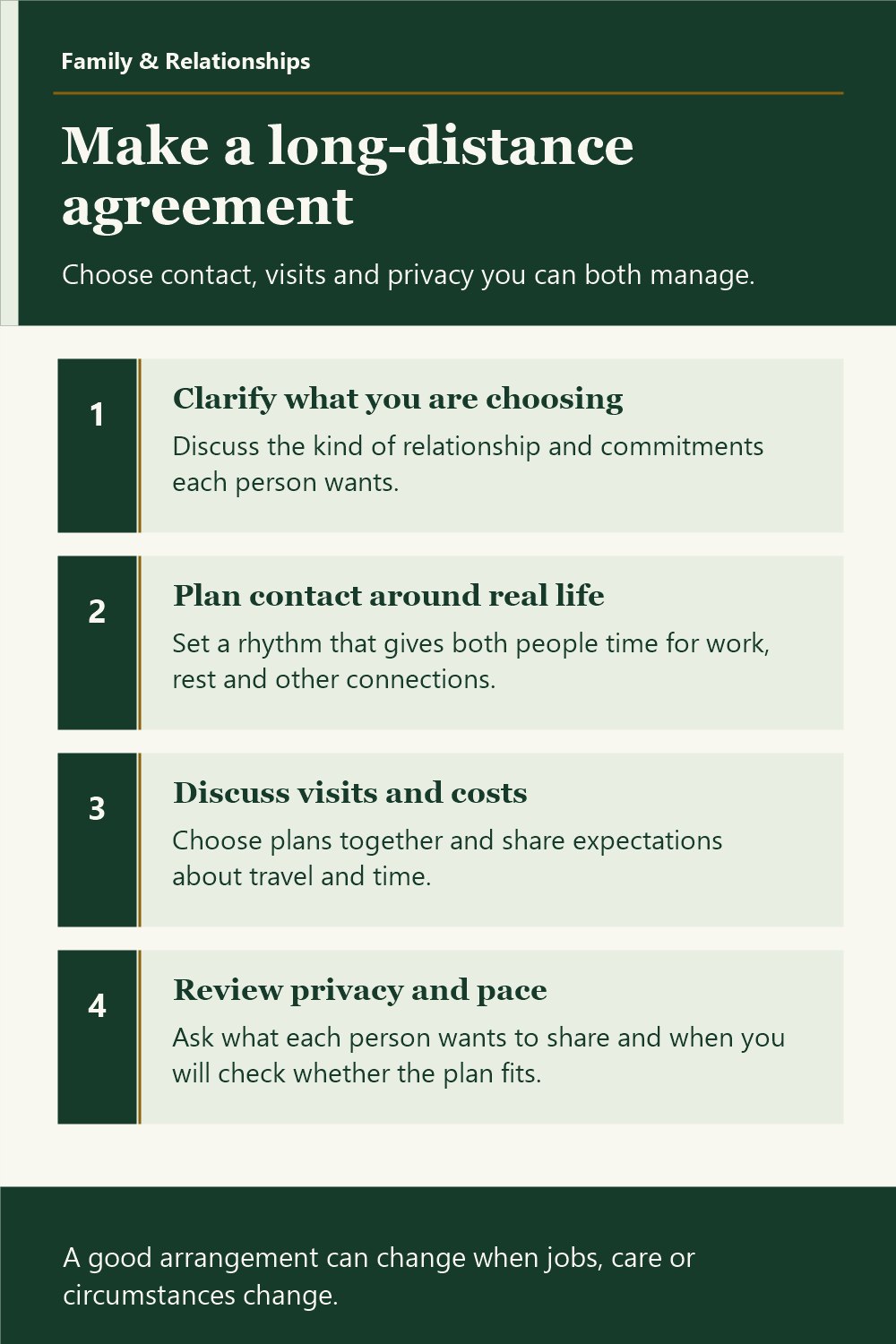
Make a long-distance agreement
Choose contact, visits and privacy you can both manage.
- Clarify what you are choosing Discuss the kind of relationship and commitments each person wants.
- Plan contact around real life Set a rhythm that gives both people time for work, rest and other connections.
- Discuss visits and costs Choose plans together and share expectations about travel and time.
- Review privacy and pace Ask what each person wants to share and when you will check whether the plan fits.
A good arrangement can change when jobs, care or circumstances change.