

Dating a friend can be appealing because you already enjoy each other’s company. It can also change a relationship you value. The useful starting point is a clear invitation and room for an honest answer, rather than trying to decode every friendly gesture.
You can take your own feelings seriously while respecting your friend’s choices. Before acting, consider what you want, how you will respond to a no and what you would need to discuss if the interest is mutual.
On this page
1. Ask yourself what you want to change
Enjoying a friendship and wanting to date are different things. Consider whether you want a romantic relationship with this person or whether loneliness, familiarity or pressure from others is driving the idea.
Think about what you value in the friendship and what dating could change. You cannot predict every outcome, but you can acknowledge that shared routines, mutual friends and expectations may be affected.
2. Ask about interest instead of reading signs
Time together, personal conversations, eye contact and affection can all be part of friendship. Flirting can be ambiguous too. None provides a reliable substitute for asking whether someone wants a date.
Jealousy is not proof of romantic interest or care. You do not need to provoke it with another person or compare how your friend treats you with how they treat everyone else.
Try a specific invitation: “Would you be interested in going on a date with me? It’s okay if you want to keep things as friends.” Say what you mean so an ordinary outing is not secretly treated as a romantic test.
3. Leave room for a freely chosen answer
Choose a private, ordinary moment when your friend can end the conversation easily. Avoid making a public declaration or asking other people to persuade them. A long explanation of everything you have done for them can create pressure rather than clarity.
If they want time to think, agree on whether they want to return to the conversation. An uncertain response is not permission to keep pushing, increase physical contact or assume you are now dating.
You can explain that the friendship matters without promising that neither person will need space. Both of you are allowed to have feelings about the conversation.
4. Respect a no and decide what space you need
If your friend does not want to date, accept the answer. Do not ask them to justify it repeatedly or treat friendship as a waiting room until they change their mind.
Disappointment may take time. You can ask for a little space without punishing them: “I respect your answer. I need a couple of weeks with less contact to settle my feelings.” If you share work or responsibilities, discuss a practical way to handle those.
Friendship may continue, change or end. There is no guaranteed way to preserve it, and neither person has to provide constant closeness to prove kindness.
5. If interest is mutual, discuss expectations
Being close friends does not mean you already know how the other person approaches dating. Talk about pace, affection, privacy and what you each want from the relationship. Ask about exclusivity rather than assuming it.
Decide together what to tell mutual friends. Keep private details private, and leave room for other friendships and activities. Familiarity can help a conversation begin; it does not guarantee honesty, compatibility or a lasting partnership.
Start with a date you both want, then check in about how it felt. You do not have to make a long-term commitment before discovering whether the romantic connection suits you.
6. Discuss how you will handle change
You may discover that you prefer friendship, or one person may want to stop dating. Talk respectfully about the decision instead of recruiting mutual friends to take sides or share private details.
If you hope to remain friends, discuss what contact is welcome and whether either person needs time apart. A return to the exact old routine may not be possible, and it does not have to happen immediately.
The aim is a choice that both people can make freely. You can be honest about wanting romance while respecting that your friend may want something different.
Read the infographic in text
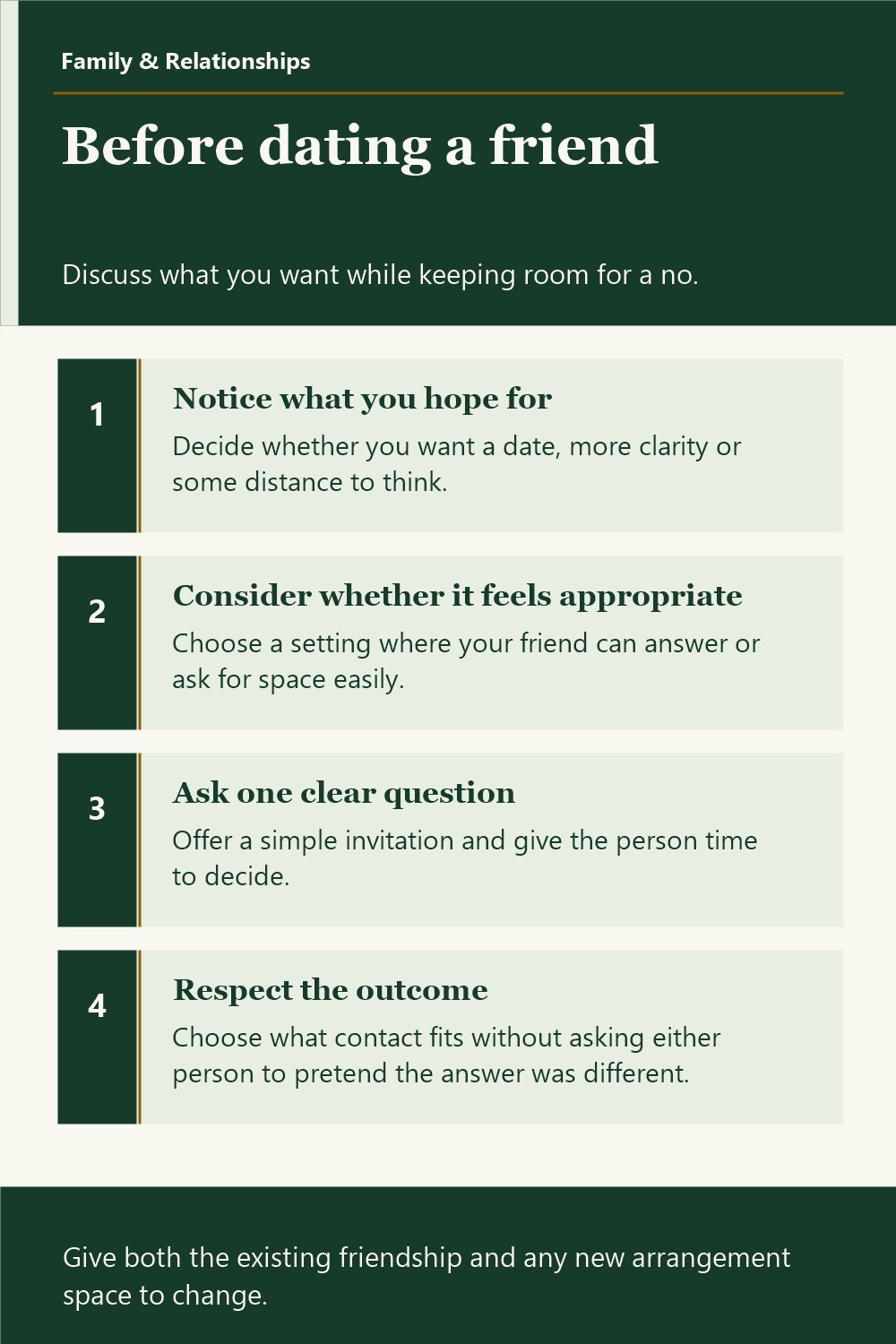
Before dating a friend
Discuss what you want while keeping room for a no.
- Notice what you hope for Decide whether you want a date, more clarity or some distance to think.
- Consider whether it feels appropriate Choose a setting where your friend can answer or ask for space easily.
- Ask one clear question Offer a simple invitation and give the person time to decide.
- Respect the outcome Choose what contact fits without asking either person to pretend the answer was different.
Give both the existing friendship and any new arrangement space to change.