

Dating a friend can feel appealing because you already enjoy each other’s company. Familiarity may give you useful knowledge about the person, but friendship does not establish romantic interest, compatibility or a guarantee that nobody will get hurt.
Before making a move, consider what you want, whether you can ask without pressure and how a change might affect your shared circles. You can value the friendship whether you choose to explore dating or keep it as it is.
In this article
Consider what you want to explore
Ask whether you want a date with this person or mainly want certainty about what your closeness means. You may enjoy friendship, feel attraction or hope for a partnership. Those wishes can overlap, but they are not interchangeable.
Think about what you know from experience and what remains unknown. You may have seen how your friend treats others, while knowing little about their expectations around exclusivity, intimacy or time together. Being comfortable in a group is different from choosing a romantic relationship.
Notice expectations you have not discussed
If you have been doing favours while hoping they will eventually date you, pause that unspoken arrangement. Help and friendship do not create a romantic debt. Offer only what you are comfortable giving as a friend, and make a separate invitation if you want to explore something more.
Ask about interest without assuming
A friend’s warmth, frequent messages or willingness to confide in you does not prove attraction. You do not need to collect enough clues to make rejection impossible. A clear, considerate question can give them room to express what they want.
Choose a moment when they can respond freely. Avoid a public declaration that makes an audience part of the answer, or an invitation when they rely on you for a ride home. You can be straightforward without making the conversation dramatic.
Make one clear invitation
You could say, “I’ve been interested in going on a date with you. Would you like that, or would you prefer to stay friends?” Give them time if they want it. A hesitant answer is not a reason to persuade, and a no does not need to be followed by a request for detailed justification.
Treat a first date as a new experience
If you both want to try, choose a manageable plan and describe it as a date. Discuss expectations instead of assuming that years of friendship mean the relationship should become serious immediately. You can discover attraction, find that dating feels unfamiliar or decide you prefer friendship.
Physical affection still needs mutual agreement. Knowing each other well does not give either person permission to kiss or touch without checking that it is welcome. There is no required pace for a friendship becoming romantic.
Respect an answer that differs from yours
If your friend declines, acknowledge the answer and stop pursuing. “Thanks for being honest; I understand” can be enough. You may need some distance to handle disappointment. Explain that as a choice about your own contact, rather than a way to make them reconsider.
Discuss shared friends and privacy
Dating within a friendship group can affect gatherings, confidences and existing plans. If you start dating, ask what you are both comfortable sharing. You do not need to announce a first date to everyone, and neither person should have to keep a relationship secret against their wishes.
Keep other friendships meaningful. A new partner does not automatically outrank everyone in every situation, and a friend’s needs do not always cancel a couple’s plans. Consider urgency, prior commitments and what help you can actually offer instead of relying on a rule about who always comes first.
Keep confidences out of group discussions
Do not ask mutual friends to investigate romantic feelings or convince the person to date you. If you need support, talk about your own feelings while respecting private information you were trusted with. You can ask for company without turning a friendship group into an audience for the decision.
Leave room for the relationship to change
No conversation can guarantee that the friendship will remain exactly the same. If dating does not work, either person may want time apart or different boundaries. You can aim to be considerate without promising an immediate return to the old dynamic.
Choose contact that suits both people afterwards
Discuss practical matters such as shared activities or returning belongings. Continued friendship has to be welcome to both people; it cannot be required as proof that the relationship mattered. A pause, occasional contact or an ending can each be a respectful outcome.
A useful next step is small: reflect on your wishes, make one invitation or decide to keep the friendship as it is. Dating a friend is a possibility to consider together, not a test of how loyal, attractive or deserving either of you is.
Read the infographic in text
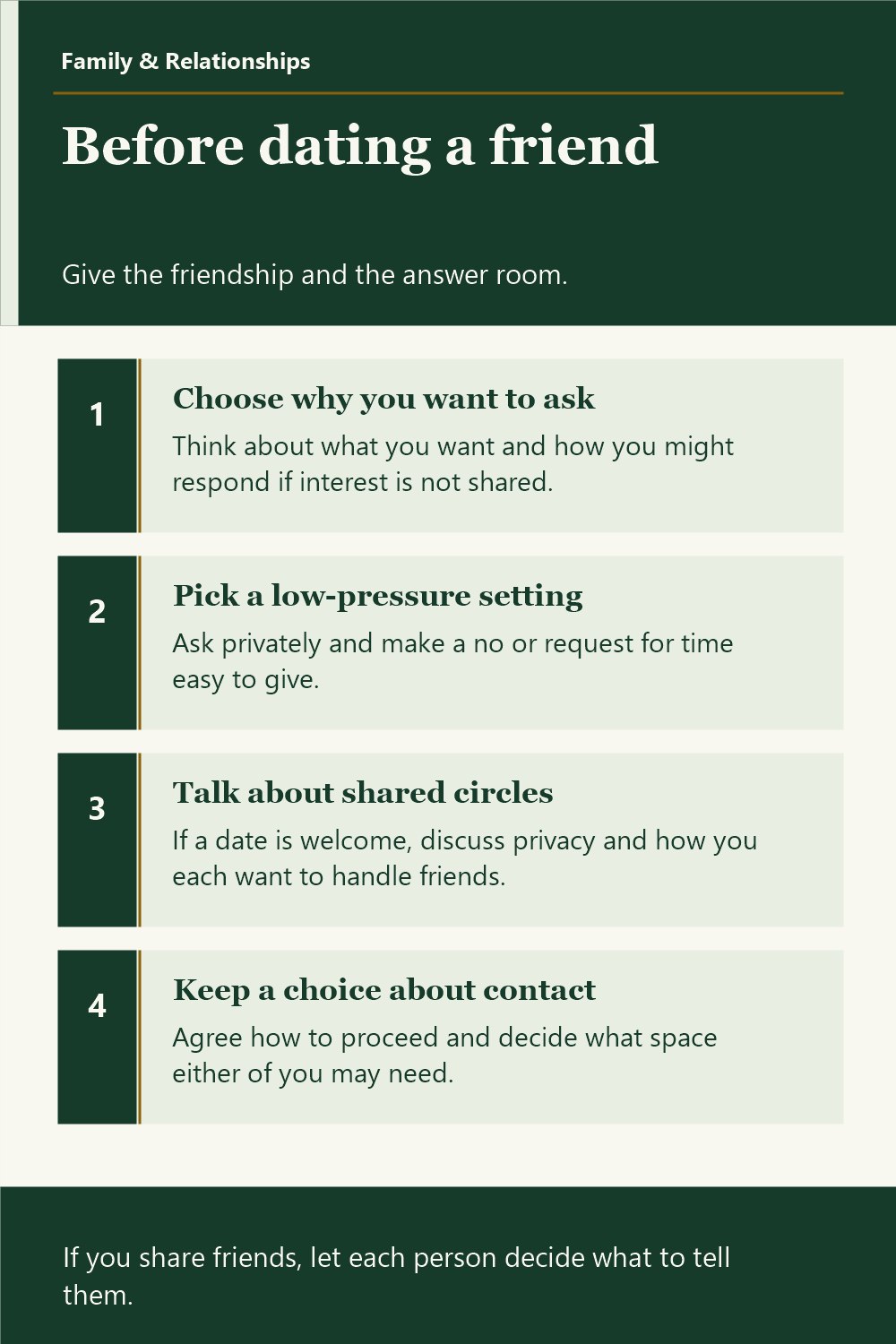
Before dating a friend
Give the friendship and the answer room.
- Choose why you want to ask Think about what you want and how you might respond if interest is not shared.
- Pick a low-pressure setting Ask privately and make a no or request for time easy to give.
- Talk about shared circles If a date is welcome, discuss privacy and how you each want to handle friends.
- Keep a choice about contact Agree how to proceed and decide what space either of you may need.
If you share friends, let each person decide what to tell them.