

Wanting commitment is a reasonable relationship preference. Wondering whether a man will ever offer it can also leave you analysing every message. A clearer starting point is what each of you wants, what you have agreed and how the relationship works now.
A direct conversation gives you more useful information than testing how jealous he becomes or counting signs. These questions can help you decide what you want to ask and what you are willing to accept.
On this page
- What kind of commitment do you want?
- What has he actually said?
- Do actions support the agreement?
- Is there room for both people’s needs?
- Are you mistaking jealousy for care?
- Does the relationship fit your life?
- Are your dating agreements clear?
- What are you willing to wait for?
- What choice can you make now?
1. What kind of commitment do you want?
Commitment can mean exclusivity, making regular time together, living together, marriage or sharing responsibilities. Those are different agreements. Be specific about what matters to you rather than waiting for a label to answer every question.
Try: “I want an exclusive relationship with someone who is interested in building a future together. Is that something you want with me?” Choose a time when you can both speak freely.
2. What has he actually said?
If he says he does not want a relationship, take that answer seriously. You do not have to prove that his reason is good enough, solve his past or persuade him to feel differently.
“Not now” does not establish what he will want years from now. It does tell you what he is offering today. Decide whether that works for you without treating a possible future change as a promise.
3. Do actions support the agreement?
Look at concrete patterns: making plans, following through, communicating changes and taking shared responsibilities seriously. One cancelled date is different from months of repeatedly leaving you waiting.
Describe the pattern rather than assigning a motive: “Our last three plans were cancelled without another date suggested. I need more reliable time together.” Listen to the response and notice what happens afterward.
4. Is there room for both people’s needs?
A relationship should allow discussion of time, affection and decisions that affect you both. That does not require access to every private thought, password or family conversation.
Not meeting relatives yet may reflect distance, family conflict, cultural expectations or another circumstance. Ask what it means in this relationship; it is not a universal commitment test.
5. Are you mistaking jealousy for care?
A partner can be devoted without becoming jealous. Monitoring your messages, restricting friendships or demanding proof of your whereabouts does not demonstrate a deeper commitment.
Love is respect’s guide to boundaries distinguishes limits that protect your choices from attempts to control another person. Look for respect and reliability rather than possessiveness.
6. Does the relationship fit your life?
Consider whether contact happens only on terms that leave you unhappy, such as late-night invitations with no other shared time. Explain the change you want and ask whether it is realistic.
Work, caregiving and health demands can affect availability. Understanding those limits does not obligate you to accept an arrangement that consistently fails to meet your needs.
7. Are your dating agreements clear?
Do not assume exclusivity, and do not assume you must date other people to make someone commit. Ask directly about the agreement you both want, including relevant sexual-health conversations.
Honour existing agreements while discussing changes. Using another date, a jealousy test or a threatened breakup to force an answer does not create freely chosen commitment.
8. What are you willing to wait for?
You can allow time for a genuine discussion without waiting indefinitely. If you agree to revisit the question, choose a date and identify what needs clarification. A review date is a chance to assess the situation, not a deadline by which someone must love you.
You may also decide that the current answer is enough. Caring about someone and recognising an incompatibility can both be true.
9. What choice can you make now?
You cannot determine whether he will “never” commit by counting signs. You can decide what to do with the relationship available now: continue by mutual agreement, change the arrangement or step away.
You might say: “I care about you, but I want a committed partnership. Since we want different things, I’m ending the dating relationship.” You do not need to bargain against a clear refusal.
If you fear retaliation or feel controlled, seek support before initiating a confrontation. If uncertainty about finding love keeps you stuck, read When You Worry You Will Never Find Love.
Read the infographic in text
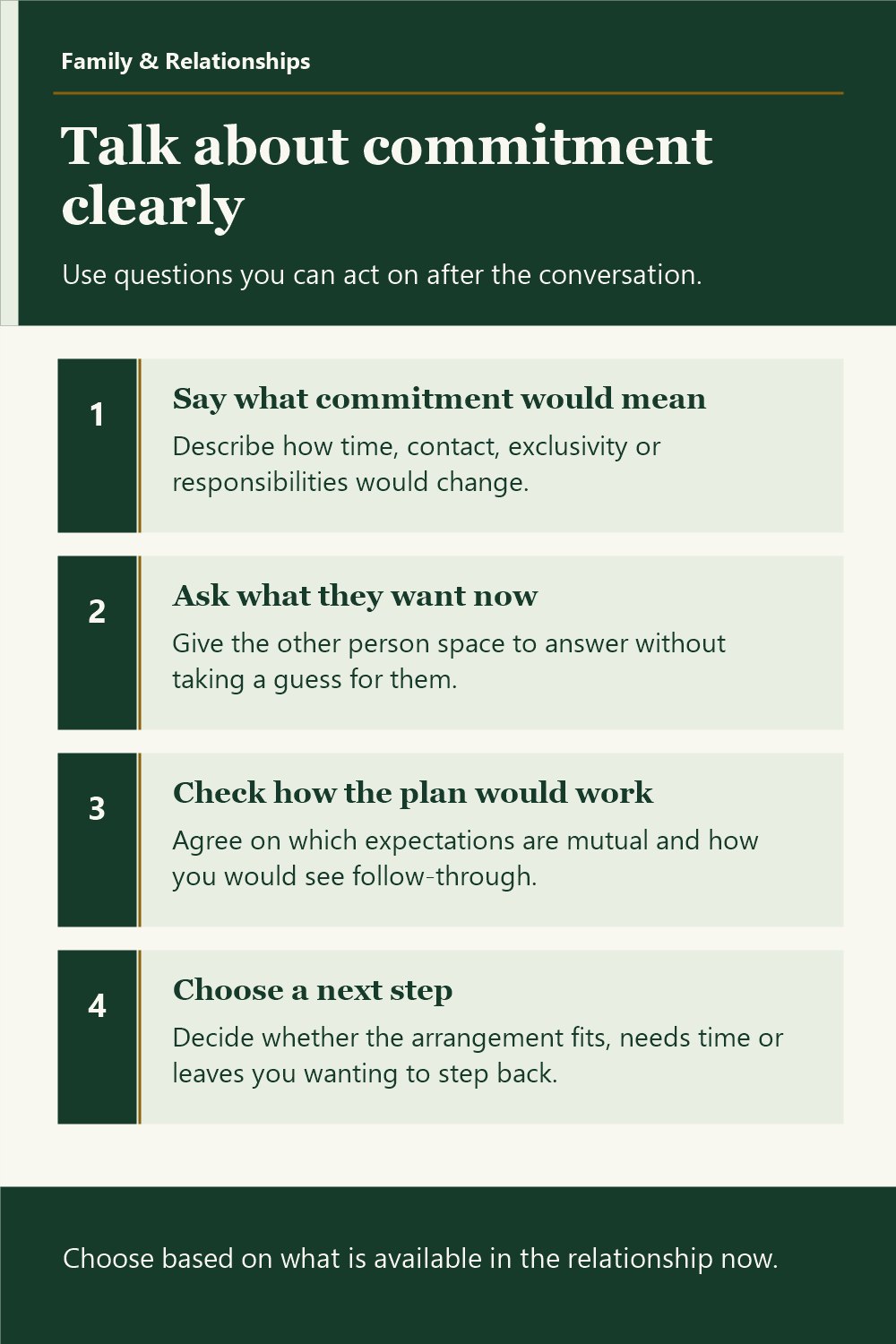
Talk about commitment clearly
Use questions you can act on after the conversation.
- Say what commitment would mean Describe how time, contact, exclusivity or responsibilities would change.
- Ask what they want now Give the other person space to answer without taking a guess for them.
- Check how the plan would work Agree on which expectations are mutual and how you would see follow-through.
- Choose a next step Decide whether the arrangement fits, needs time or leaves you wanting to step back.
Choose based on what is available in the relationship now.