

When affection and hurt are mixed together, you may wonder whether a partner’s love is real. A checklist cannot tell you what is inside another person’s mind, but their repeated actions can help you decide what you want to accept.
A caring relationship can include disagreements, hard days and uncertainty. You do not have to call someone’s feelings fake to recognize that a pattern is hurting you or that the relationship does not meet your needs.
1. You can set a limit without punishment
Notice what happens when you say no, ask for privacy or choose time with friends. Respect leaves room for a decision the other person dislikes; it does not require agreement with every preference.
For example, “I do not want to share my phone password” is a boundary you can state directly. Threats, monitoring, humiliation or repeated pressure are reasons to take the situation seriously, even when affection follows.
If saying no feels unsafe, you do not have to stage a confrontation to test the relationship. Speak privately with a trusted person or a local domestic-abuse support service about options.
2. Words and actions can be discussed openly
Trust grows through things you can actually notice: keeping an agreement, explaining a changed plan and acknowledging a mistake. It does not require knowing someone’s thoughts or receiving constant proof of loyalty.
If a promise is not kept, ask about that specific event rather than trying to establish whether every feeling was genuine. “We agreed to tell each other before changing the plans. What happened?” gives the conversation a clear focus.
An explanation may help you understand, but you can still decide that repeated dishonesty is unacceptable. You are allowed to need consistency.
3. Both people’s needs have room
Care can look like listening, sharing practical work or adjusting a plan when one person is having a difficult week. It should not mean that one person routinely gives up sleep, money, friendships or important goals to keep the other content.
Fairness does not always mean splitting every task equally. It does mean being able to discuss capacity and revise arrangements rather than treating sacrifice as the price of love.
Illness, disability, sadness or difficulty with self-care do not prove that someone cannot love. Discuss the support each person can offer and what additional help is needed without making either partner responsible for everything.
4. You can remain separate people
Partners can have different tastes, beliefs and ambitions. Being understood usually involves asking and listening, not expecting someone to read your mind.
Try describing a preference concretely: “I enjoy quiet weekends, and I also want us to plan time together.” Then listen to what the other person wants. Neither person has to become an identical version of the other.
Some differences affect whether a relationship can continue, such as wanting children or a particular kind of commitment. Naming an incompatibility is more useful than assuming that greater love will make it disappear.
5. Conflict leads to responsibility and follow-through
An apology is more useful when it names the behavior, recognizes its effect and is followed by a change. “I was upset” can explain a feeling without excusing an insult or broken agreement.
When a conversation becomes heated, you can agree to pause and choose a time to return to it. A pause needs a shared purpose; it should not become a way to punish someone with indefinite silence.
You can forgive and still keep a boundary. For a structured conversation, see six questions about whether a relationship can be repaired.
6. Staying together remains a choice
No relationship promises uninterrupted happiness or permanence. Length alone does not establish that a relationship is caring, and an ending does not erase every good moment that came before it.
Ask yourself: Can I speak honestly here? Are important agreements being respected? Is there willingness to address the same recurring problem? What do I need if nothing changes?
Consider the pattern over time while taking serious incidents seriously. You can choose a conversation, firmer limits, support or an ending without proving that the other person never loved you.
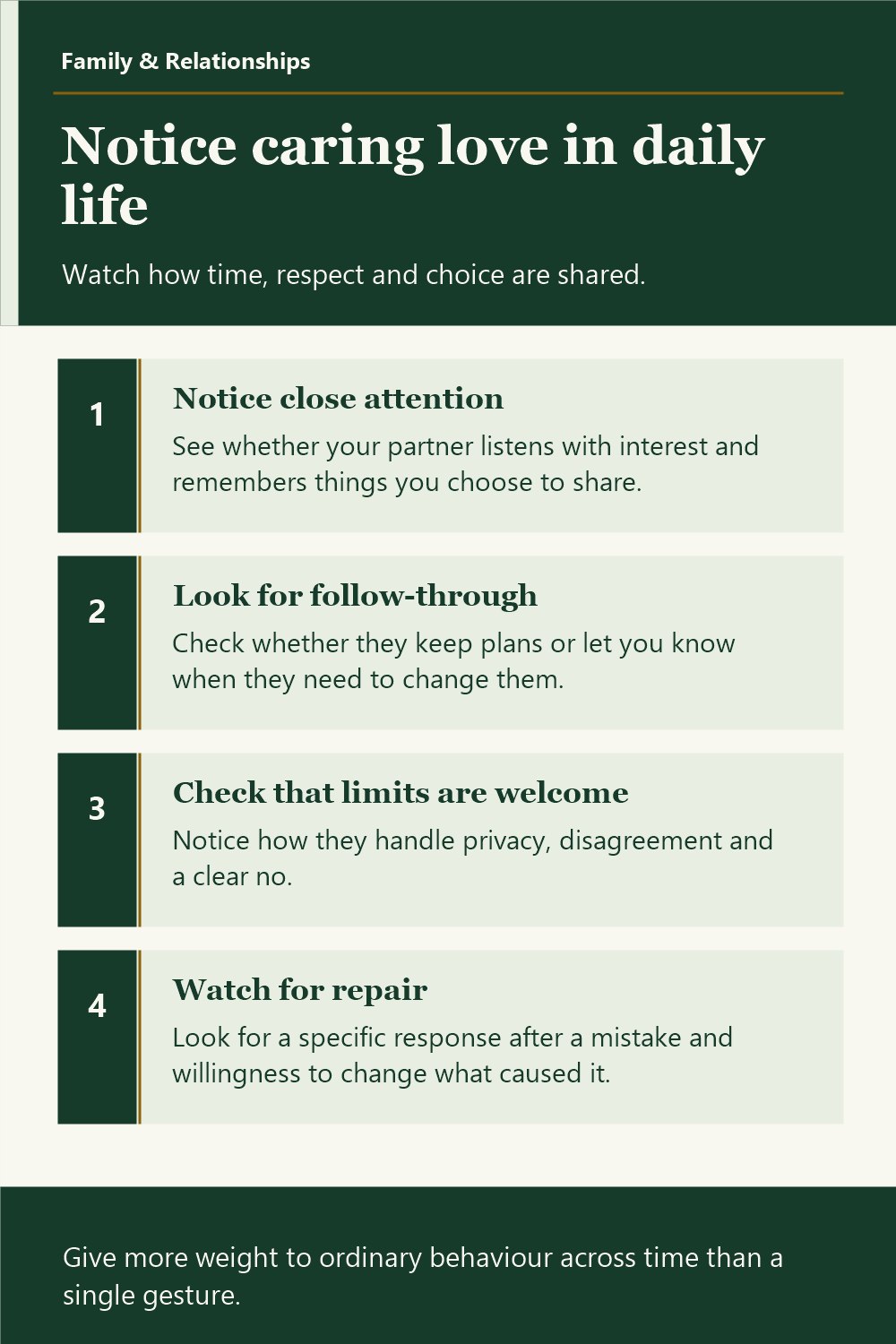
Read the infographic in text
Notice caring love in daily life
Watch how time, respect and choice are shared.
- Notice close attention See whether your partner listens with interest and remembers things you choose to share.
- Look for follow-through Check whether they keep plans or let you know when they need to change them.
- Check that limits are welcome Notice how they handle privacy, disagreement and a clear no.
- Watch for repair Look for a specific response after a mistake and willingness to change what caused it.
Give more weight to ordinary behaviour across time than a single gesture.