

Losing a partner or relationship can leave you facing feelings and practical changes you did not choose. You do not have to feel grateful, find a positive lesson or start dating again to show that you are coping.
The next step depends partly on what happened. Bereavement, a breakup and a separation bring different needs. Give yourself room to name the loss, cover immediate responsibilities and seek support that fits your situation.
On this page
- Name the loss you are living with
- Make room for mixed feelings and memories
- Cover the next practical need
- After a breakup, decide what contact is necessary
- Choose support that fits the loss
- Rebuild manageable parts of your day
- Approach dating and intimacy in your own time
- Let reflection come when it is useful
1. Name the loss you are living with
The death of a partner, a breakup and a separation are different experiences. Each can change your routines, sense of the future and relationships with other people. Advice about contacting an ex will not fit bereavement, and practical decisions will depend on your circumstances.
If a partner has ended the relationship, their decision still needs to be respected, even when you wish it were different. If someone has died, you may be finding ways to live with their absence rather than choosing whether to reconnect.
2. Make room for mixed feelings and memories
You may remember affection, ordinary routines, disappointment or harm. The relationship does not have to have been perfect to matter, and it does not have to have been entirely bad for its ending to feel necessary.
Gratitude is optional. You do not need to turn the loss into a lesson, focus only on happy memories or thank someone who hurt you. Missing a person is not evidence that you should return to them.
Let yourself decide which memories you want close and which you need a break from. You might keep a photograph, put belongings away temporarily or ask friends not to bring up a particular subject.
The NHS guide to grief and loss explains that feelings can vary and that people do not move through grief in a fixed, orderly sequence. There is no single emotional response you need to demonstrate.
3. Cover the next practical need
Choose what needs attention soon: meals, medication you already use, childcare, a bill, transport or a place to stay. Make a short list and identify what can wait. You do not have to resolve every decision at once.
Ask for a specific kind of help if you can: “Could you bring dinner on Tuesday?” or “Would you sit with me while I organise these papers?” For legal or financial questions after a death or separation, seek advice appropriate to your location and situation.
4. After a breakup, decide what contact is necessary
Contact can keep a hope alive or make everyday tasks harder. Consider what you want now, what the other person has requested and whether shared responsibilities require a practical channel. A period without personal updates may be useful if it is workable and safe.
Keep arrangements about children, belongings or bills separate from attempts to restart the romance. Do not use friends or children to pass emotional messages. If contact involves threats, coercion or fear, seek support suited to your safety rather than feeling obliged to have a closure conversation.
5. Choose support that fits the loss
You might want company, a place to talk, help with daily responsibilities or a quiet activity with someone you trust. Let people know whether you want listening or practical suggestions. You can decline advice that does not fit.
Writing privately may help you express something you do not want to send. A bereavement group, counsellor or qualified health professional may also be useful, especially if you are struggling to manage daily life. If you feel unable to stay safe, seek urgent local help.
6. Rebuild manageable parts of your day
Return to an activity because it gives your day some shape or matters to you, not because you must prove you have moved on. Start small: a familiar walk, a meal with a friend or a task you can finish.
New experiences are optional. You can enjoy something and still feel sad later. Rest, ordinary routines and enjoyable moments do not erase the importance of the person or relationship you lost.
7. Approach dating and intimacy in your own time
You do not owe anyone a new romance, and you do not have to rule one out forever. If you choose to date, be honest about what you can offer now. Another person should be able to make an informed choice too.
Share personal information at a pace that feels comfortable. Being vulnerable does not guarantee that someone will respond well or remove all uncertainty. Trust can develop through respectful behaviour over time.
Sex is not a required step in healing or proof of love. Any intimacy should be freely wanted by everyone involved. You can pause, change your mind or prefer companionship without sexual contact.
You do not need to change your appearance or hide your history to deserve consideration. Look for whether the connection makes room for your boundaries and present needs.
8. Let reflection come when it is useful
Later, you may want to consider what you valued, what you would choose differently or what support you want in future relationships. You may not want to do that today. A worthwhile next step can be as ordinary as accepting help, covering one practical need or spending an evening somewhere you feel comfortable.
Read the infographic in text
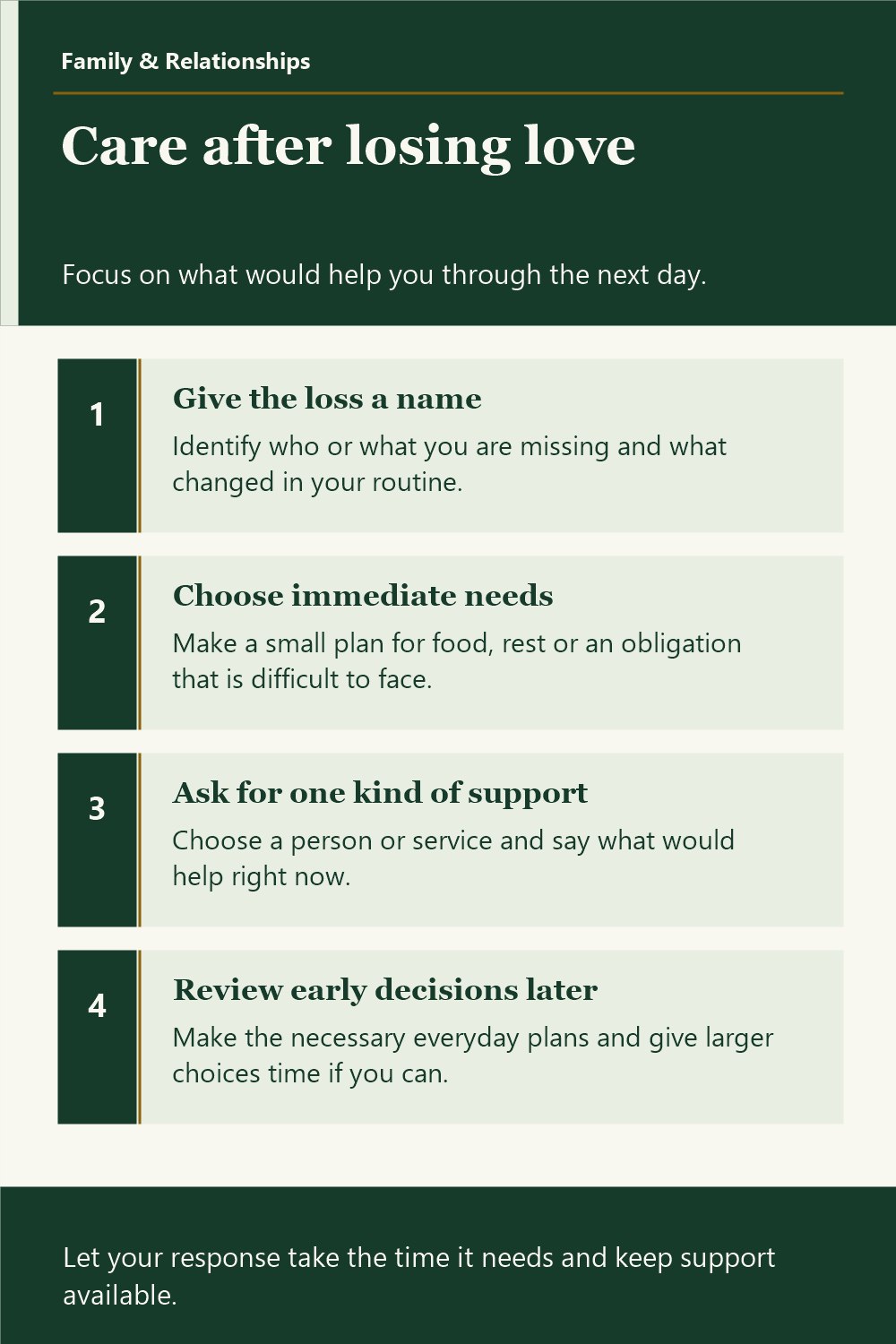
Care after losing love
Focus on what would help you through the next day.
- Give the loss a name Identify who or what you are missing and what changed in your routine.
- Choose immediate needs Make a small plan for food, rest or an obligation that is difficult to face.
- Ask for one kind of support Choose a person or service and say what would help right now.
- Review early decisions later Make the necessary everyday plans and give larger choices time if you can.
Let your response take the time it needs and keep support available.