

Breaking up and getting back together can leave you unsure where the relationship stands. You may care about each other and still feel worn down by repeated endings, uncertain promises or changes of plan. Missing someone does not settle whether another reunion would meet your needs.
An on and off relationship is a pattern to examine, rather than proof that either person is incapable of change. Give yourself room to consider what actually happens between breakups and reunions, what you want now and whether you can choose freely.
On this page
Make room for a decision without pressure
You do not have to answer a request to reunite immediately. If it feels safe, a simple response can create space: “I am not ready to decide today. Please do not make plans on the assumption that we are back together.”
Consider what is influencing the decision. Affection, loneliness, shared housing, money, children, family expectations and a long history may all matter. Having practical reasons for finding separation difficult does not make you weak or responsible for someone else’s harmful behaviour.
Friends can listen or help with an arrangement without choosing for you. Be clear about the help you want, such as a place to talk, company while collecting belongings or time to think without repeated questions about whether you have decided.
Look at what keeps repeating
Try separating the reason for the last breakup from the reason for the last reunion. The breakup may have followed an unresolved disagreement, while the reunion happened because you missed familiar company. Both experiences can be real without the original difficulty having changed.
Ask concrete questions rather than deciding who is the problem:
- What led to the most recent separation?
- What did each person say would be different?
- What happened when the same difficulty returned?
- Were agreements followed when doing so was inconvenient?
- Could either person ask for time or decline contact without punishment?
A disagreement about where to live needs a different conversation from repeated insults or pressure. A reunion does not require you to treat every problem as a mutual failure or compromise on consent and basic respect.
Take your feelings and safety seriously
You might feel relief, dread, attraction and uncertainty at different moments. Feelings can help you notice what needs attention, but they cannot tell you another person’s private intentions or predict how a reunion will turn out.
Notice the circumstances around those feelings. Does your unease follow a broken agreement, or are you worried about disappointing someone? You can take a concern seriously without waiting until you have a complete explanation or a label for the relationship.
If there are threats, monitoring, sexual pressure or fear about saying no, seek confidential individual support from a domestic abuse service. You do not need to arrange a face-to-face confrontation or another trial period to justify asking for help. Love is respect’s discussion of on and off relationships offers further perspective on respect and repeated breakups.
Discuss what a reunion would involve
If both people freely want to consider trying again, discuss the relationship you would be entering now. Returning to familiar routines can leave important questions unanswered, including whether you are exclusive, what contact you expect and which plans are actually agreed.
Make proposed changes specific. “We will communicate better” could become “When either of us needs a pause during a disagreement, we will say so and agree when to return to the conversation.” A pause is different from announcing a breakup to force agreement.
Leave room to assess what happens over time. An apology, a warm weekend or an ambitious promise does not require you to renew shared finances, move in together or make another commitment. Either person can decide the proposed relationship does not fit, even if some things have improved.
Make an ending workable if that is your choice
If you choose to end the relationship, you can be clear without arguing every part of its history. When safe to communicate, you might say: “I do not want to restart our relationship. I want to keep any further contact to arranging the return of our belongings.”
Separate necessary arrangements from conversations about getting back together. Shared parenting, a tenancy or financial commitments may require advice and a suitable contact plan; simply blocking every channel may not fit your circumstances. Agree practical details only where doing so is safe, and get appropriate help with unresolved responsibilities.
Make space for ordinary care afterwards: meals, rest, people you trust and commitments you can manage. You may still miss the person. That feeling does not cancel your decision or oblige you to offer another chance.
Read the infographic in text
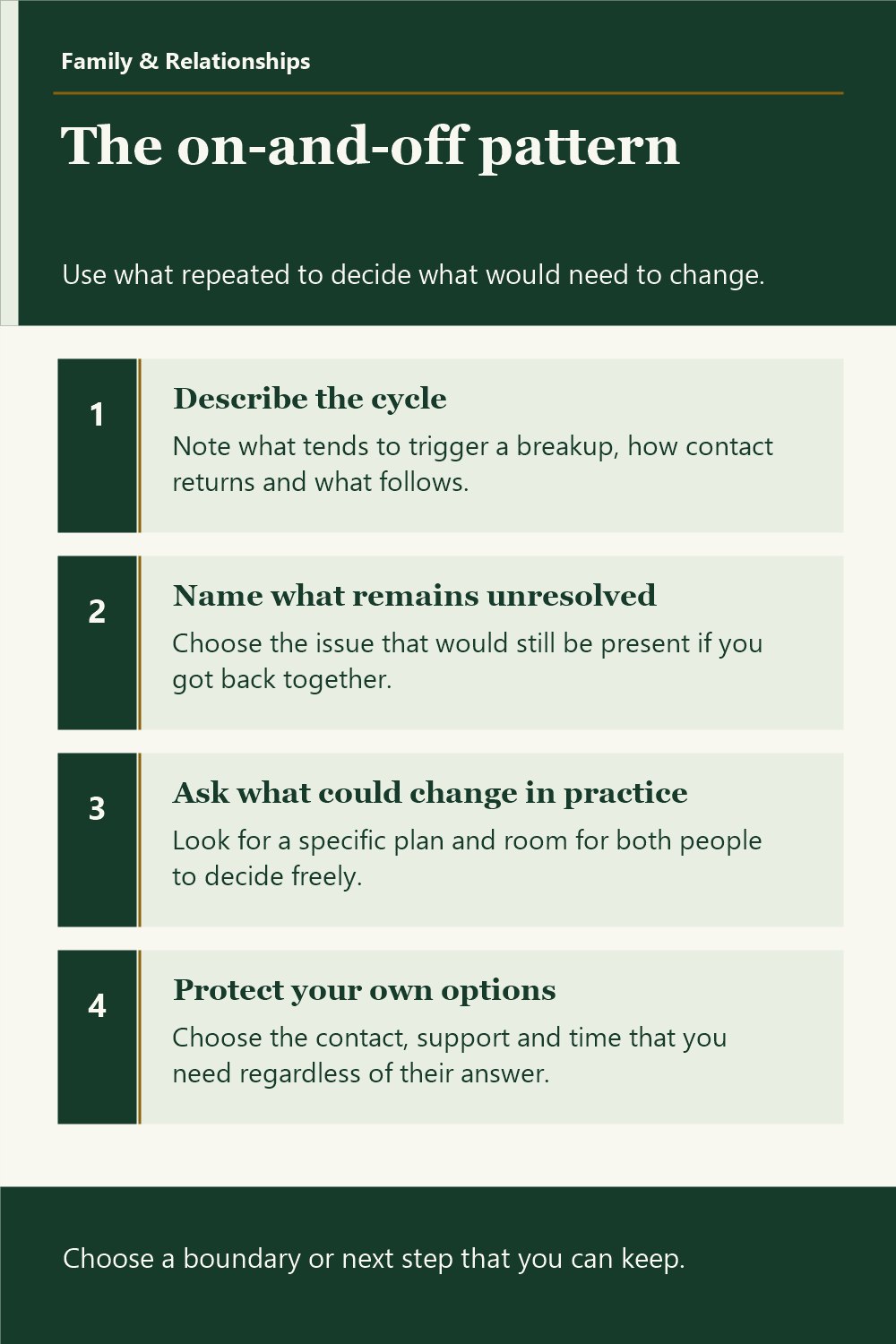
The on-and-off pattern
Use what repeated to decide what would need to change.
- Describe the cycle Note what tends to trigger a breakup, how contact returns and what follows.
- Name what remains unresolved Choose the issue that would still be present if you got back together.
- Ask what could change in practice Look for a specific plan and room for both people to decide freely.
- Protect your own options Choose the contact, support and time that you need regardless of their answer.
Choose a boundary or next step that you can keep.