

When a relationship feels strained, you may wonder whether to keep working on it, take some space or leave. Boredom, a disagreement or a quieter period does not provide a simple answer. Neither does a list of signs that promises to decide for you.
Consider how the relationship treats both people, what needs to change and whether you freely want to continue. You can take concerns seriously without deciding that either person is entirely good or bad. You also do not have to prove that a relationship is beyond repair before choosing to end it.
On this page
1. Start with safety, rather than a repair plan
Ask whether you can disagree, decline sex or contact, maintain friendships and raise a concern without intimidation or retaliation. Threats, coercion, violence or controlling access to money and communication need attention beyond ordinary advice about getting along.
If you fear a partner’s response, a confrontation or announcement about leaving may not be the safest first step. Consider private support from a suitable domestic abuse service or trusted person, using a safer device if yours may be monitored.
The National Domestic Violence Hotline explains why joint therapy is not recommended with an abusive partner, including the risk that disclosures may be used against the person experiencing abuse. Seek individual, specialist support instead of treating abuse as a shared communication problem. If there is immediate danger, prioritise appropriate local emergency help.
Our guide to hurtful or controlling behaviour, choices and support offers more on describing a concern and considering safety without needing a perfect label.
2. Describe what is happening before interpreting it
Name an event or pattern you can discuss: repeated cancellations, an unfair care arrangement, insults during disagreements or important decisions being made without a conversation. “Our agreed plans have been cancelled three times” is clearer than assuming you know exactly how much someone loves you.
Consider the context without using it to dismiss the effect. Illness, shift work or caring responsibilities may affect time and energy. You can understand those circumstances and still ask what practical arrangements would support both people.
Notice what happens when you raise the issue. Is there room to explain, listen and disagree? Does the conversation lead to a decision or leave the same concern unresolved? You do not need to ignore a serious event while waiting to establish a pattern.
3. Ask what a meaningful change would involve
If discussion feels safe and both of you want to try, choose a specific issue. Avoid a broad promise to be “better partners” without agreeing what either person would actually do.
- What needs attention?
Name the agreement, action or responsibility that is not working.
- Who will do what?
Choose a realistic change each person is willing and able to make.
- How will you review it?
Agree when to discuss what happened, without treating a deadline as a guarantee.
For example, if one person carries the household planning, “help more” may need to become responsibility for a particular task, including remembering and arranging it. If conversations repeatedly become insulting, the issue includes stopping that behaviour and taking responsibility for it.
Look at what follows an apology or agreement. A reassuring conversation can matter, but you cannot carry out someone else’s part of the change. Neither time spent together nor a single romantic gesture establishes that a problem has been resolved.
4. Consider compatibility and everyday care
You do not need identical interests or constant excitement to have a worthwhile relationship. Consider whether the quieter parts of life include consideration, reliability and room for each person’s preferences.
Some differences concern choices neither person should have to make under pressure: having children, exclusivity, sexual activity, where to live or the role of a belief or tradition. Understanding why something matters does not require agreeing to it.
Acceptance also does not mean accepting every action. You can respect a person’s individuality while asking for honesty or deciding that an arrangement does not fit your needs. Shared affection does not automatically settle a substantial difference.
Our article on shared values, voluntary closeness and everyday care includes ways to explore meaning together without demanding the same beliefs or experiences.
5. Choose support that leaves room for your decision
A trusted person or qualified counsellor can help you organise your thoughts without needing to decide for you. Ask for the kind of help you want: listening, considering options or preparing for a practical conversation.
The NHS’s guidance on relationships and wellbeing discusses listening, checking what you understood, taking a pause during conflict and protecting your own capacity to help. These can support a conversation when it is safe to have one.
Couples counselling may be an option when both people freely want it and it is appropriate to the situation. It cannot promise that you will stay together. The safety distinction above still applies: intimidation or abuse calls for specialist individual guidance.
Keep room for support outside the relationship. Your partner does not have to be the only person you confide in, and privacy does not require handling every difficulty alone.
6. Choose a next step you can stand behind
You might agree to work on a specific issue, take time to reflect or decide to leave. If you discuss a pause, clarify practical arrangements and contact expectations rather than assuming that both people mean the same thing.
If you choose to end the relationship, you do not need the other person’s agreement that your reason is good enough. Equally, you cannot require someone else to continue a relationship because you want to repair it. Respect their answer and seek support for your own feelings and practical needs.
Shared housing, money or care responsibilities may require further planning and appropriate local professional advice. If safety is a concern, seek private support before discussing plans. You can make one useful decision at a time without turning uncertainty into an obligation to stay.
Read the infographic in text
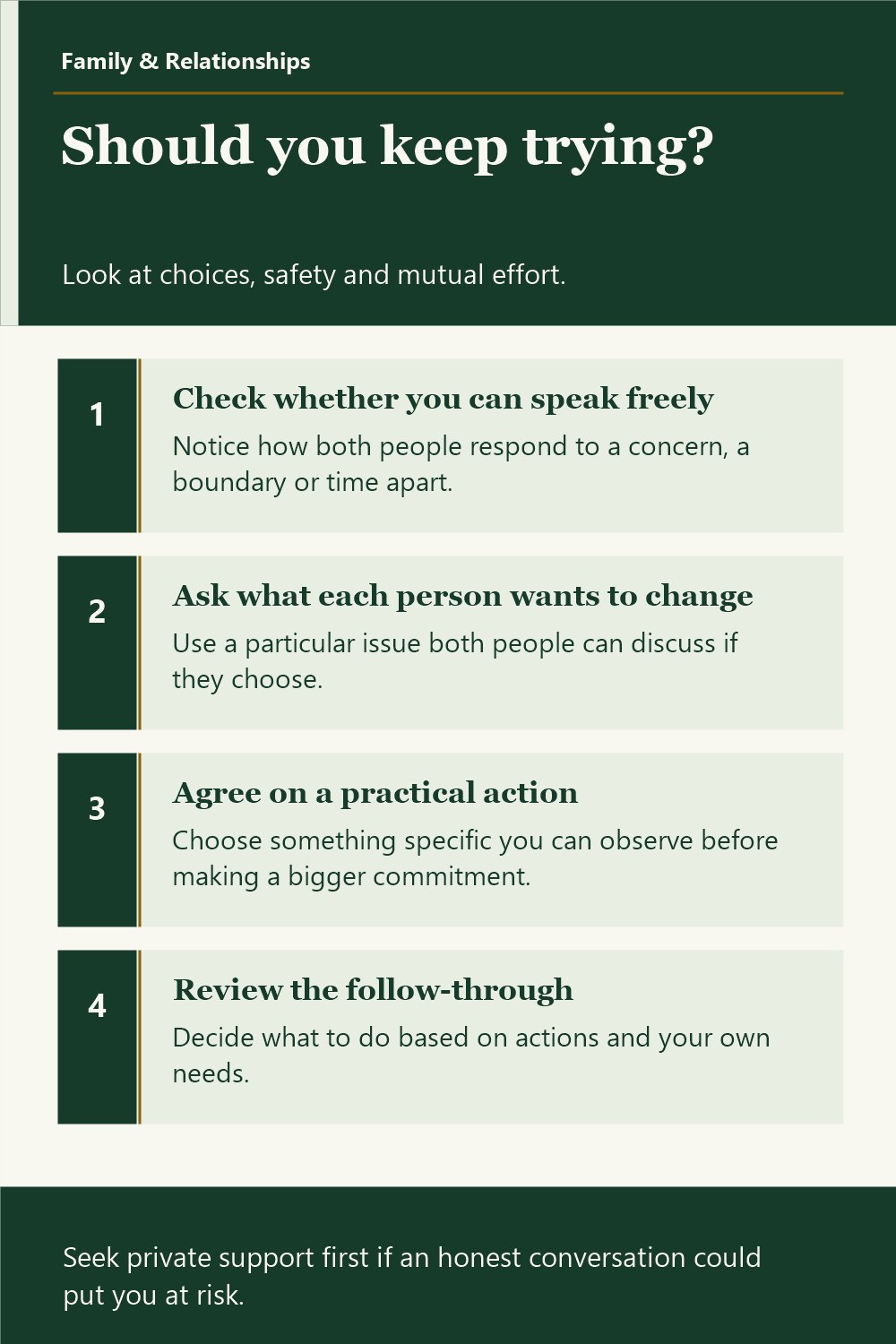
Should you keep trying?
Look at choices, safety and mutual effort.
- Check whether you can speak freely Notice how both people respond to a concern, a boundary or time apart.
- Ask what each person wants to change Use a particular issue both people can discuss if they choose.
- Agree on a practical action Choose something specific you can observe before making a bigger commitment.
- Review the follow-through Decide what to do based on actions and your own needs.
Seek private support first if an honest conversation could put you at risk.