

You can care about someone and feel worn down by the relationship. Exhaustion alone does not tell you whether to stay or leave. It can be a reason to look carefully at what is happening, what you need and whether both people want to respond.
Start with one recent situation rather than trying to explain the whole relationship at once. Concrete examples can make it easier to identify a request, a limit or a decision that needs your attention.
On this page
1. Describe what feels exhausting
“I’m tired of loving you” can mean many things: planning everything, repeatedly asking for contact, feeling unheard or wanting a different relationship. Start with the situation rather than deciding what it proves about your worth.
Write down a recent example and its impact: “I organised our last three visits, and I feel alone in keeping us connected.” Distinguish a repeated pattern from a difficult week.
2. Identify the need behind the disappointment
You may want affection, dependable time, shared work or clarity about commitment. A present, flowers or a particular phrase may matter to you, but your partner may not understand what you associate with it.
Translate the disappointment into a request: “I’d like us to plan one evening together this week,” or “I need you to take responsibility for arranging the next visit.” A clear request gives you something specific to discuss.
3. Talk about affection without assuming
People differ in how much touch, conversation and time together they enjoy. Ask what feels welcome to each of you. Physical affection should be freely wanted; a relationship does not make anyone obligated to provide touch or sex.
Neither person has to read the other’s mind. Equally, you should not have to repeat a clearly understood need forever while nothing changes. Notice whether both of you are willing to engage.
4. Look at shared effort over time
Effort will not be exactly equal every day. Illness, disability, parenting or work may change what each person can do. Discuss capacity and fair arrangements rather than keeping a rigid score.
The important questions are whether responsibilities are acknowledged, whether decisions include you and whether promises lead to action. An explanation can help you understand a limit without making the arrangement sustainable for you.
5. Ask for a conversation you can assess
When it feels safe to talk, choose one issue and a time when neither of you is rushing. Explain what happened, how it affected you and what you are asking for. Invite their view without abandoning your own.
For example: “I miss spending time together. Could we each suggest one plan for next week and agree on one tonight?” If you agree on a change, decide when to revisit it. Pay attention to follow-through, not only reassuring words.
For help deciding whether another attempt fits your situation, read Should You Keep Trying in Your Relationship?
6. Decide what you are willing to continue
Your partner may be willing to make changes, uncertain or clear that they do not want the same relationship. You can listen without treating an unwanted answer as a challenge to overcome.
You might continue with a new agreement, seek suitable support together or end the relationship. You do not need to prove that someone is a bad person before acknowledging that the relationship does not work for you.
If you are considering separation, think through practical needs such as housing, shared responsibilities and trusted support. How to Move on After a Relationship offers a place to continue reflecting.
When the issue is fear or control
Threats, coercion, monitoring and fear deserve a different response from an ordinary disagreement about attention. You do not have to confront someone or arrange a joint conversation to earn support.
If you are worried about your safety, The Hotline’s safety-planning resources can help you consider options. Use a safer device if you think your activity is being monitored.
Love can matter deeply while the relationship still leaves you depleted. A useful next step starts with what is happening, what you need and which choices are available to you.
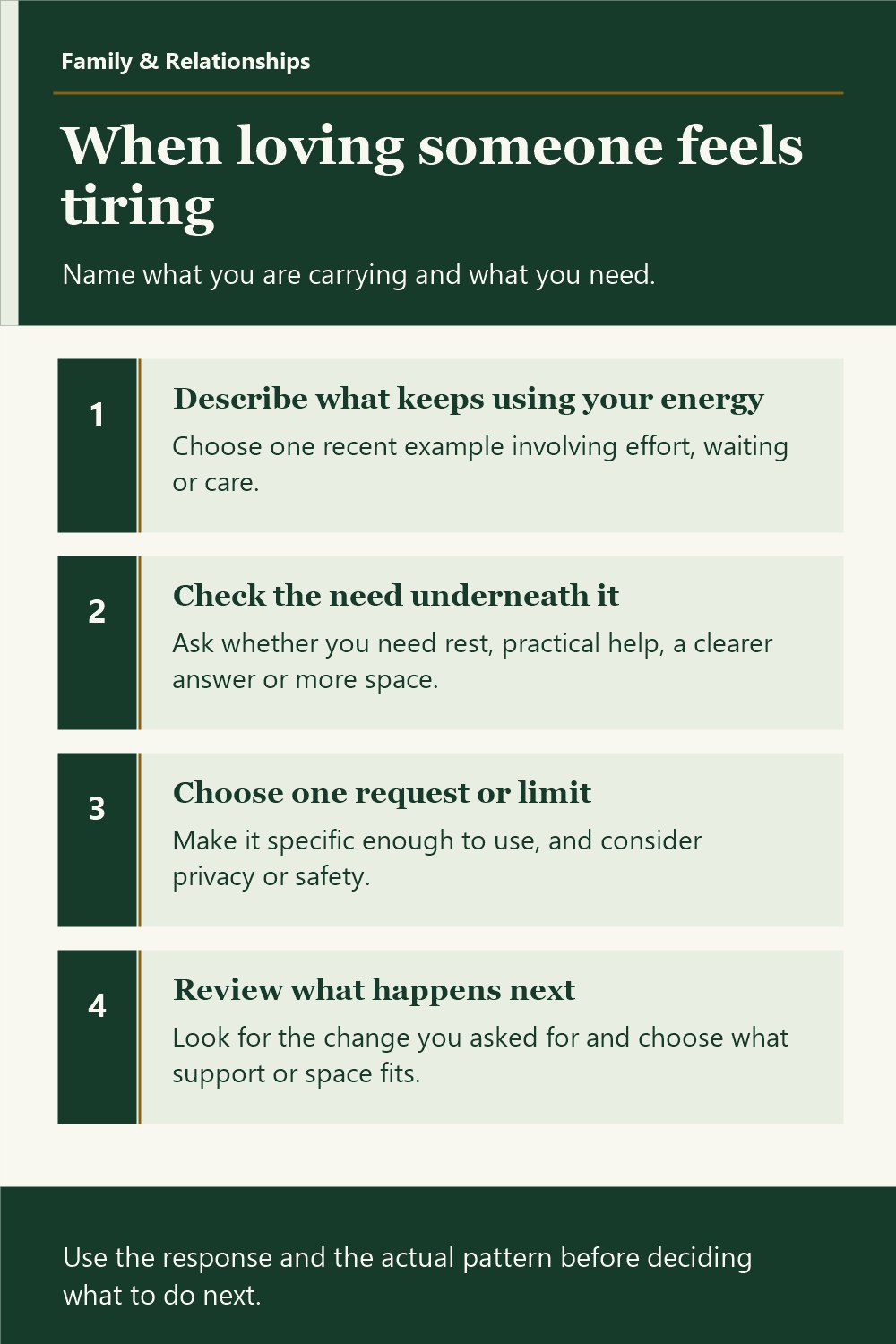
Read the infographic in text
When loving someone feels tiring
Name what you are carrying and what you need.
- Describe what keeps using your energy Choose one recent example involving effort, waiting or care.
- Check the need underneath it Ask whether you need rest, practical help, a clearer answer or more space.
- Choose one request or limit Make it specific enough to use, and consider privacy or safety.
- Review what happens next Look for the change you asked for and choose what support or space fits.
Use the response and the actual pattern before deciding what to do next.