

Caring about someone and feeling unhappy with the relationship can happen at the same time. The useful question is what keeps happening, how it affects you and whether a change is both safe and realistic.
Working on a relationship requires more than remembering its best moments. Use these questions to understand the current pattern, discuss concrete changes where appropriate and consider the choices available to you.
1. Is it safe to disagree?
Strong feelings during a disagreement do not by themselves tell you whether a relationship is repairable. Look at behavior: can you pause, speak freely and leave a conversation without threats or retaliation?
Each person is responsible for their own actions. Problems are not automatically an equal share of blame, and abuse is the responsibility of the person using it. You do not need to identify something you did wrong to take harmful behavior seriously.
If there is intimidation, control or violence, seek private support from an appropriate specialist rather than assuming a joint conversation or couples therapy is the next step. The National Domestic Violence Hotline explains concerns about couples therapy in abusive relationships. Consider a safe way to access support.
2. What keeps happening?
Replace a broad judgment such as “I cannot stand them” with specific observations. Are plans repeatedly ignored, tasks left to you, private information shared or arguments handled with insults? Different problems need different responses.
If you repeatedly break up and reunite, ask what changes between those moments. Missing each other or feeling relieved after making up does not show that the original issue has been addressed.
Write down one recent example, what happened next and what you would need to be different. Keep private notes only in a way that is safe in your circumstances.
3. What do you want to keep or change?
Name what you value about the person and the relationship without using those qualities to dismiss a recurring hurt. Affection can be real while an arrangement is still unsuitable for you.
Consider what you want from a relationship now: companionship, commitment, shared responsibility, intimacy, independence or other needs. Ask which of those are being met and which are repeatedly set aside.
Time and effort already invested may explain why a decision feels difficult. They do not oblige you to keep investing or establish that you must leave. Focus on what is happening now and what the available choices would mean for your life.
4. Are both people willing to take part?
A wish to reconnect needs participation from both people. You can be willing to listen or change a habit without becoming responsible for the other person’s effort.
Ask rather than assuming your partner feels the same: “Do you want to work on this relationship, and what are you willing to do differently?” Allow an honest answer, including uncertainty or a no.
Notice whether willingness becomes action. Agreeing in the moment and repeatedly refusing the same practical step are different patterns. You cannot make a shared repair plan work through your effort alone.
5. What would a change look like?
When discussion is safe, choose one specific request: “If a plan changes, please tell me before I leave home.” Explain your own next step as well, such as checking that a meeting is confirmed before travelling.
A list of benefits and difficulties can organize your thoughts, but it cannot calculate whether a relationship is “meant to be.” Give attention to the significance of each concern, especially safety, rather than counting points.
Agree on a manageable action and a time to discuss the result. Where appropriate, a qualified relationship professional may help with ordinary communication or shared problems; choose support with attention to your circumstances and the safety concerns above.
6. What does your experience tell you?
At the review point, ask whether the agreed behavior actually changed and whether you feel more able to speak and choose freely. A difficult conversation can reveal useful information even if it does not lead to reconciliation.
You may choose to continue, revise the plan, take space or end the relationship. Consider practical responsibilities and support without treating any one option as proof of success or failure.
If the relationship ends, you can seek support while grieving the loss. Making a considered decision does not remove the feelings that may follow it.
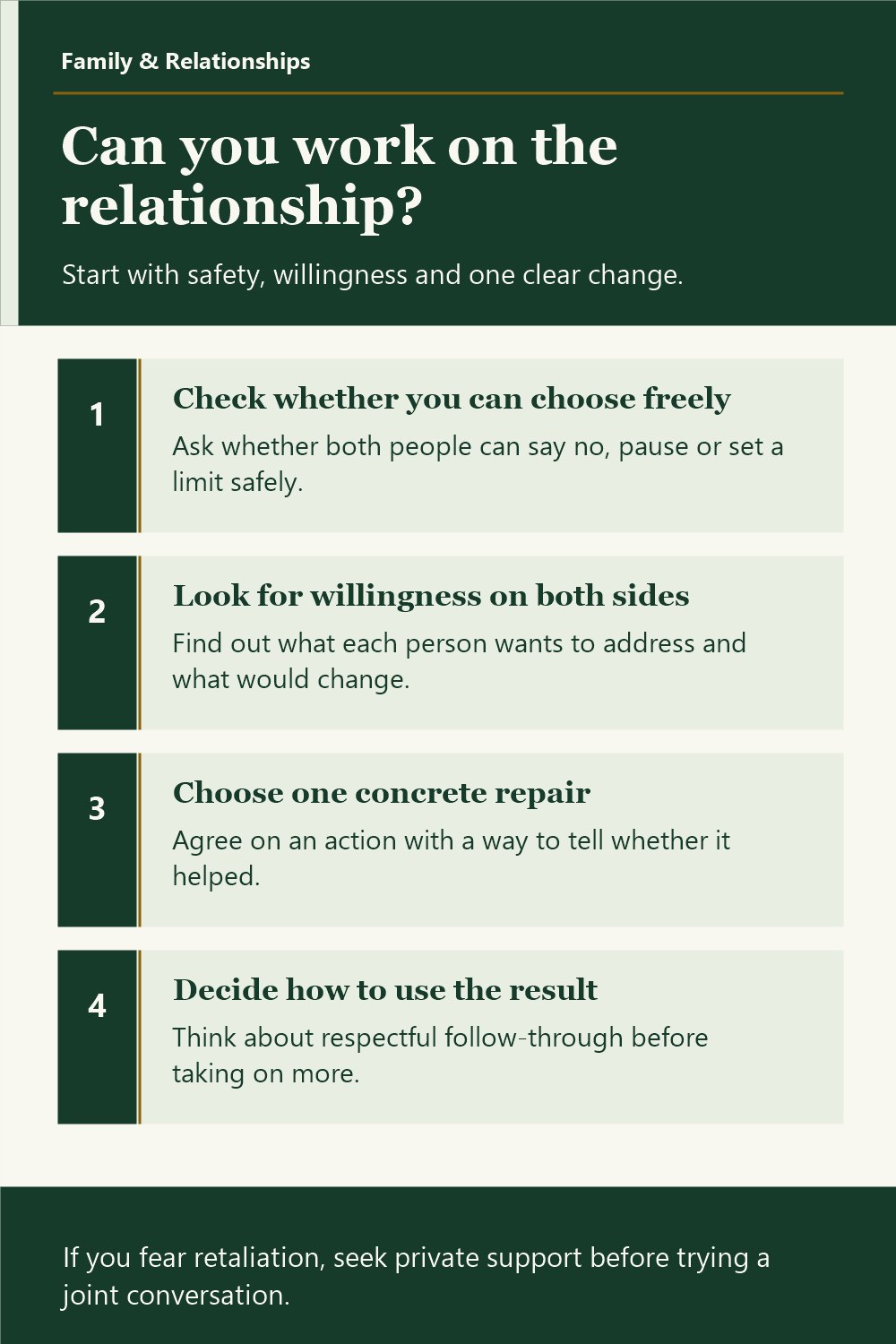
Read the infographic in text
Can you work on the relationship?
Start with safety, willingness and one clear change.
- Check whether you can choose freely Ask whether both people can say no, pause or set a limit safely.
- Look for willingness on both sides Find out what each person wants to address and what would change.
- Choose one concrete repair Agree on an action with a way to tell whether it helped.
- Decide how to use the result Think about respectful follow-through before taking on more.
If you fear retaliation, seek private support before trying a joint conversation.