

If heart-chakra imagery is meaningful to you, you can use it as a way to pause and reflect on care, closeness and your own needs. You do not have to produce a particular sensation or feel loving all the time.
Choose the parts of these practices that fit you. Sadness, caution or difficulty trusting someone does not mean that your heart is defective or that you must open yourself to a relationship you do not want.
1. Begin in a position that feels comfortable
Sit, stand or rest in a way that suits your body. Let your arms settle where they feel comfortable; you can keep your eyes open and simply look around the room.
You might notice the support of a chair or your feet resting on the floor. There is no required posture, stretch or exercise to complete before beginning.
If focusing inward feels uncomfortable, turn your attention to something ordinary nearby or finish the practice. Stopping is a choice you can make, not a sign that you have failed.
2. Use an image only if it helps you reflect
You might picture a soft green light, a favorite place or a color that you associate with kindness. Let it be an image you choose rather than something you must see clearly.
If you prefer, skip visualization and notice an actual object in the room. A plant, a fabric texture or daylight through a window can be a simple point of attention.
Keep breathing comfortable rather than forcing deep breaths or holding them. You do not need to interpret warmth, tingling or an absence of sensation as a message about your capacity to love.
3. Choose words that leave room for how you feel
A short phrase can give the reflection a focus. Try “I can care for myself today” or “I can be kind and keep my boundaries.” You can say it silently, speak softly or write it down.
Choose wording you can live with. If “I love everything about myself” feels too far away, a smaller statement such as “I am willing to listen to what I need” may feel more useful.
You do not need to repeat a phrase until your mood changes. Let the words be an invitation to notice, rather than a demand to feel differently.
4. Ask what needs attention in your everyday life
Consider a gentle question: “What has been asking for my attention?” You might notice a need for rest, company, privacy or a conversation you have been postponing.
Writing one sentence can help you remember the thought. You do not have to explain every feeling or find a spiritual cause for it.
Keeping a boundary can be an expression of care too. Reflection does not require forgiving someone immediately, accepting unwanted contact or reopening a relationship.
5. Finish with one practical act of care
Choose something small that follows from what you noticed: prepare a meal, take a break, contact a supportive person or make time for an interest you enjoy.
If you want to return to the practice, keep it brief enough to fit comfortably into your day. You can also decide that another kind of reflection suits you better.
When distress is persistent or daily life feels hard to manage, consider support from a counselor or healthcare professional. Spiritual reflection can be part of what matters to you while you also ask for practical help.
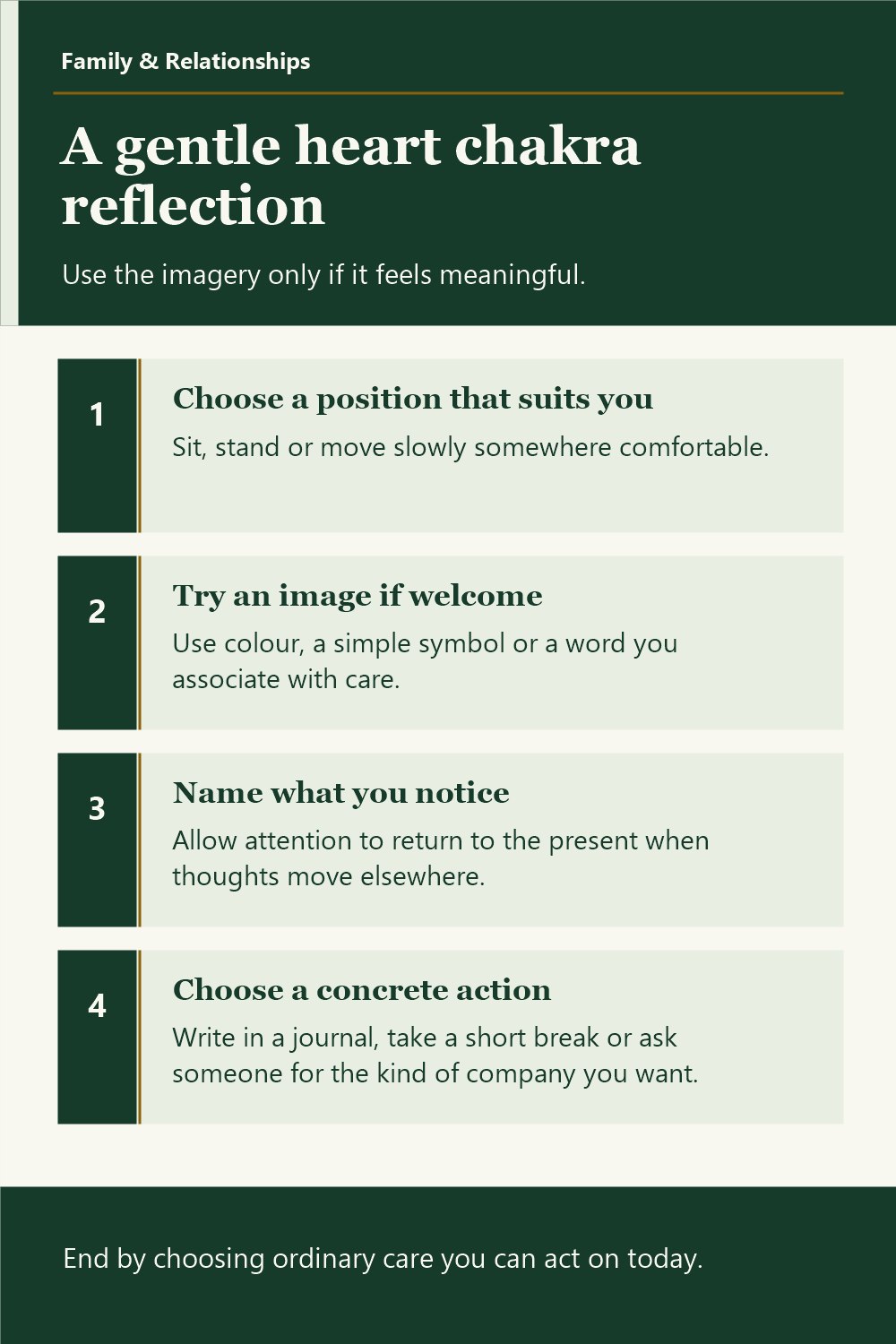
Read the infographic in text
A gentle heart chakra reflection
Use the imagery only if it feels meaningful.
- Choose a position that suits you Sit, stand or move slowly somewhere comfortable.
- Try an image if welcome Use colour, a simple symbol or a word you associate with care.
- Name what you notice Allow attention to return to the present when thoughts move elsewhere.
- Choose a concrete action Write in a journal, take a short break or ask someone for the kind of company you want.
End by choosing ordinary care you can act on today.