

A strong connection can feel exciting, comforting or confusing. You may trust your intuition and still wonder whether you and the other person want the same relationship.
Give your feelings room while also noticing what happens between you. You do not have to create a “meant to be” feeling in someone else to deserve a clear, caring relationship.
1. Notice your feelings without asking them to predict the future
Ask what you feel around this person: curious, relaxed, energized, uncertain or guarded. Try naming the feeling before deciding what it proves.
If intuition has spiritual meaning for you, it can be part of your reflection. It cannot establish another person’s thoughts, intentions or future choices. A calm feeling and a strong attraction are experiences to consider alongside the relationship itself.
You can take discomfort seriously without having a complete explanation. Slowing down or declining a meeting does not require proof that something is wrong.
2. Look at the pattern of everyday behavior
Notice how the person handles plans, listens when you disagree and responds to a boundary. A caring message matters, but so does whether the arrangements you discuss actually happen.
One awkward conversation may need clarification. A repeated pattern of saying one thing and doing another gives you different information. Describe the pattern as specifically as you can.
Avoid creating tests or trying to provoke jealousy to find out what someone feels. Direct questions and freely chosen interactions give both people more room to be honest.
3. Ask what kind of relationship each person wants
If the connection is unclear, you might ask, “Are you interested in dating with a view to commitment, or do you want something more casual?” Share your own preference too.
Take an answer seriously even if it is disappointing. Someone who says they are unsure has not promised that greater patience or a different version of you will change their mind.
If their answer changes repeatedly, ask what they can offer now. You can decide that the uncertainty does not suit you without trying to solve their feelings for them.
4. Discuss the differences that affect a shared life
Chemistry does not settle questions about children, money, commitment, faith, living arrangements or time together. Choose the questions that matter to the stage of your relationship.
You may share important values while enjoying different interests. The useful question is whether you can make workable choices and respect each other’s lives.
Some differences remain significant even when affection is strong. Recognizing an incompatibility is not a failure to listen to your heart.
5. Keep room for the rest of your life
Think about what you enjoy outside this connection and which relationships or responsibilities you want to maintain. You do not need to become constantly available to appear interested.
Your own interests can matter for their own sake. They are not techniques for making yourself irresistible or convincing another person to commit.
Notice whether you can say what you think and make ordinary choices without fearing punishment or losing affection. A relationship should leave room for you to remain a separate person.
6. Choose a next step that fits what you know
You might want another date, a conversation about commitment, a slower pace or an ending. Base the step on both your feelings and what the other person has actually communicated.
If you continue, choose something specific to discuss or observe rather than waiting for a single sign that removes all doubt. If you leave, a strong connection does not obligate you to keep trying.
You can value intuition while allowing everyday information to change your view. Neither person needs to be persuaded that a relationship was destined in order to choose it freely.
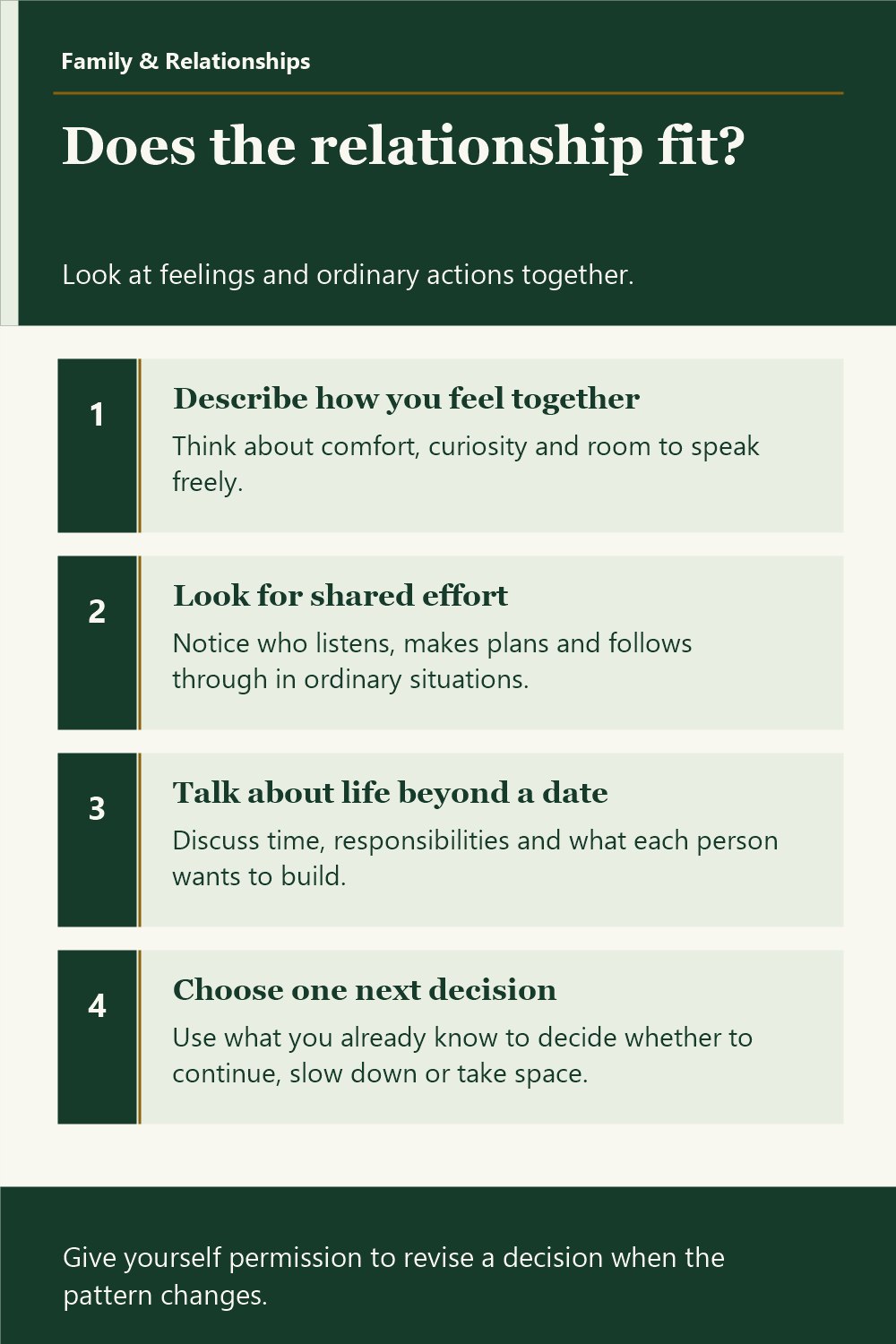
Read the infographic in text
Does the relationship fit?
Look at feelings and ordinary actions together.
- Describe how you feel together Think about comfort, curiosity and room to speak freely.
- Look for shared effort Notice who listens, makes plans and follows through in ordinary situations.
- Talk about life beyond a date Discuss time, responsibilities and what each person wants to build.
- Choose one next decision Use what you already know to decide whether to continue, slow down or take space.
Give yourself permission to revise a decision when the pattern changes.