

Replaying a conversation or checking for a reply can make a relationship feel difficult to think about clearly. Sometimes there is a practical problem to address; sometimes the same unanswered question keeps circling.
You do not have to assume that every worry is true, or dismiss yourself as insecure. Start with what you know, what you need to clarify and what you can actually choose.
1. Separate what happened from what you think it means
Write down the event in plain terms: “We agreed to talk tonight, and I have not heard from them.” Then write the interpretation separately: “They must have lost interest.”
There may be several explanations, including ones you do not like. Separating the two helps you ask a useful question without pretending that you already know the answer.
The NHS guide to reframing unhelpful thoughts suggests examining the evidence and considering other explanations. This does not require dismissing an actual breach of trust.
2. Name the question you need answered
Try turning a broad worry into a specific question. “Do they care?” may become “Are we both interested in a committed relationship?” or “Can we agree how to communicate when plans change?”
Ask whether this is a question someone can answer now, a pattern you need more time to observe or an uncertainty that cannot be resolved completely.
If there have been repeated lies, insults or ignored boundaries, include those events in your assessment. The aim is clearer thinking, not persuading yourself that everything must be fine.
3. Ask directly when a conversation is welcome and safe
Choose a manageable time and describe the event without presenting an assumption as a fact. For example: “When our plans changed without a message, I felt uncertain. What happened, and what can we agree for next time?”
Listen to the answer and notice whether it addresses the question. You can ask for clarification without repeating the same question until you receive a reassuring answer.
You do not have to confront someone if you fear their reaction. Consider private support and your options if speaking openly feels unsafe.
4. Put limits around repeated checking
Refreshing messages or asking several friends for the same interpretation may take up time without giving you new information. Consider a boundary you can manage, such as putting your phone aside while you eat.
You could write the worry down and choose a short time to review it, rather than following it through every time it appears. The NHS guidance on managing worries offers ways to distinguish practical problems from uncertainties outside your control.
If something needs action, make a specific plan. If nothing new can be done now, return to an ordinary activity without demanding that the feeling vanish first.
5. Keep your own needs in the decision
Ask what you need in the relationship: predictable plans, clarity about commitment, privacy or respectful disagreement. A need does not become unreasonable simply because someone else prefers a different arrangement.
You can propose an agreement, decide what you will do if a pattern continues or step back. You cannot make another person provide certainty or want the same relationship.
Keep room for friends, interests and rest while you decide. Your whole day does not have to become a search for signs about one person.
6. Seek support if the loop is becoming hard to manage
A trusted person can listen and help you distinguish events from interpretations. You can ask them to help you plan one next step rather than repeatedly predict what your partner feels.
If worry is persistent, distressing or interfering with sleep and daily life, a healthcare professional or counselor can help you explore support. You do not need to diagnose yourself before asking.
Choose one practical step for today: write down the concern, request a conversation or set a boundary around checking. Clearer choices can begin while some uncertainty remains.
Read the infographic in text
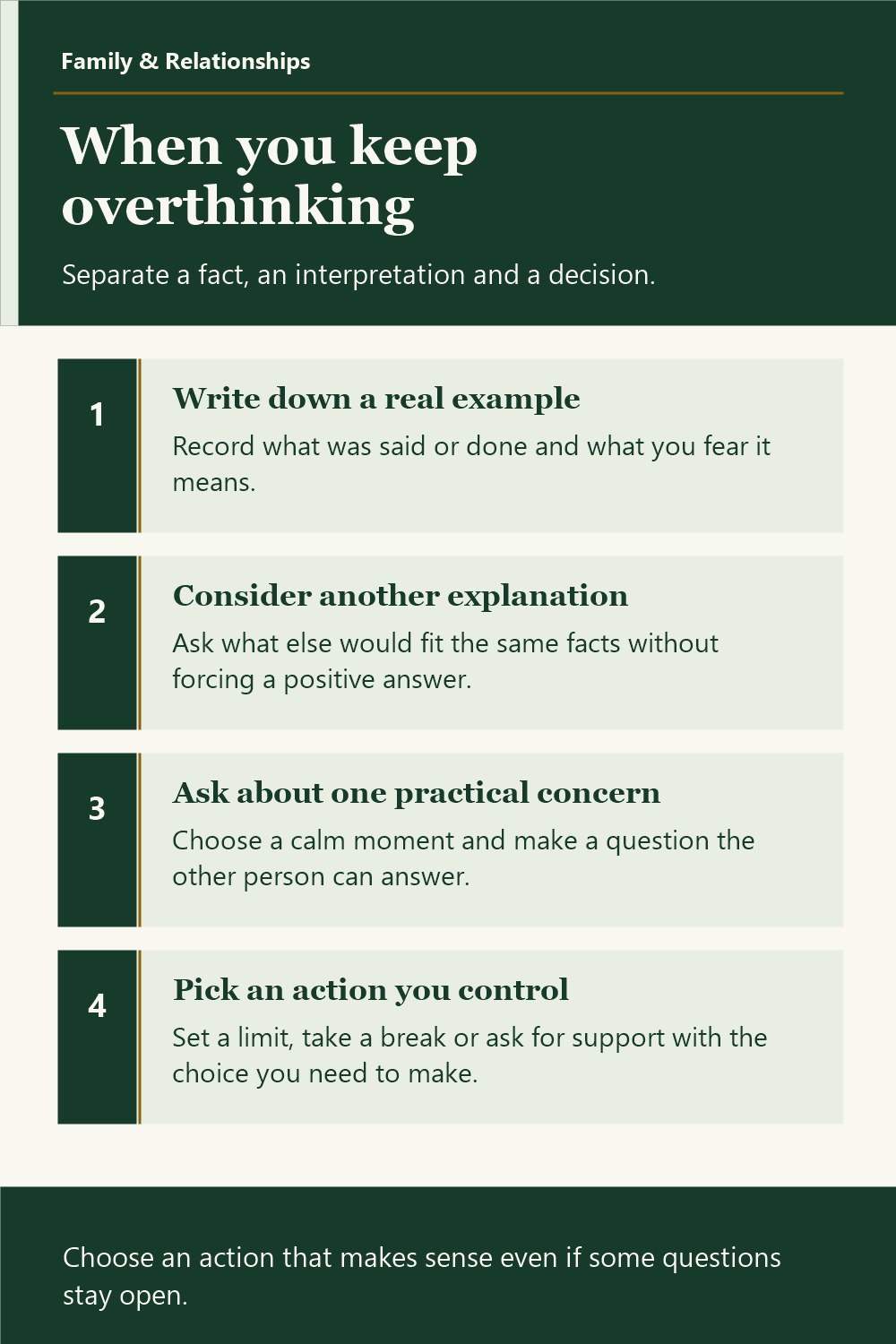
When you keep overthinking
Separate a fact, an interpretation and a decision.
- Write down a real example Record what was said or done and what you fear it means.
- Consider another explanation Ask what else would fit the same facts without forcing a positive answer.
- Ask about one practical concern Choose a calm moment and make a question the other person can answer.
- Pick an action you control Set a limit, take a break or ask for support with the choice you need to make.
Choose an action that makes sense even if some questions stay open.