

Wanting an ex back can make an apology feel urgent. Before sending one, consider what you want to acknowledge and whether contact is welcome. A useful apology takes responsibility for a particular action and leaves the other person free to decide how to respond.
You do not need to assume that the whole breakup was your fault. You can recognise something you did wrong without accepting blame for another person’s choices. These six steps focus on making an apology considerate, whether or not the relationship ever restarts.
On this page
1. Check whether an apology is welcome
If your ex has asked for no contact, respect that request. Do not send a letter through a friend, use another account or arrange an unexpected meeting to get around the boundary. Wanting to explain yourself does not establish that they want to receive the explanation.
You can write privately to clarify what happened without sending the message. If contact is welcome and there are no safety concerns, consider the channel the person is comfortable using and keep the message brief. Avoid turning an ordinary practical exchange into a surprise conversation about the relationship.
Shared parenting, belongings or other responsibilities may still require communication. Keep that contact available for its agreed purpose. Our guide to choices and necessary contact with an ex explores those arrangements in more detail.
2. Name the action you are responsible for
Choose a specific action rather than declaring that you are a terrible person or that everything went wrong because of you. “I shared information you asked me to keep private” gives the apology a clear subject. It also makes it possible to say what needs to change.
Take responsibility for that choice without attaching blame to the recipient. “I did it because you never listened” turns the apology into another accusation. A difficult feeling or disagreement can explain the context without excusing a hurtful action.
If the facts are disputed, be honest about what you know. Do not confess to something you did not do simply to end a conversation or improve the chance of a reunion. You can seek individual support if you are struggling to separate responsibility from pressure or guilt.
3. Acknowledge the impact without demanding agreement
Recognise the effect you understand, and leave room for the other person’s experience. You might know that your action exposed something private or disrupted an arrangement. You cannot decide exactly how they feel or instruct them to accept your explanation.
For a situation involving shared private information, an apology might be:
“I shared your personal news after you asked me to keep it private. That was my choice, and I am sorry. I will keep your personal details private. You do not have to reply to this message.”
The useful elements are the named action, responsibility and a relevant commitment. Use your own accurate words. Avoid a long list of compliments, a request to reassure you that you are a good person or a dramatic statement about being unable to live without them.
An apology can be emotional without being shameful. The aim is to communicate clearly while allowing the other person a real choice about whether to engage.
4. Offer a practical change you can follow through on
Consider what is within your control. That might mean keeping private information to yourself, honouring a practical agreement or seeking help to change behaviour that has hurt others. Describe the action you will take, rather than promising that the relationship will be happy from now on.
If belongings or another practical matter need attention, use an agreed way to address it. Do not turn returning an item, sending a gift or arranging help into a reason to gain unwanted access. Some offers of repair may be declined, and you need to respect that answer.
Changes matter beyond the message itself. Love is respect’s emotional-boundaries guide connects trust with consistent actions and each person’s freedom to decide when they trust. Your ex does not have to supervise your progress or offer another relationship as a reward.
5. Leave room for their response and your own limits
Your ex may reply warmly, remain upset, disagree with you or say nothing. A response is information about what they are willing to share, rather than a score for how well you wrote the apology. Do not keep sending revised messages to obtain the reaction you hoped for.
If a conversation is welcome, listen to the concern before explaining your perspective. You can acknowledge something specific: “I understand that sharing that information damaged your trust.” You do not have to agree with every statement to recognise the effect of your own action.
Taking responsibility does not require enduring threats, humiliation or sexual pressure. Either person can pause or end a conversation. If you fear retaliation or harm, seek confidential support about your circumstances instead of arranging a private meeting to prove sincerity.
6. Keep forgiveness and reconciliation freely chosen
Your ex may accept the apology and still want the relationship to remain over. They may also need time or choose not to forgive. You can continue making responsible changes without treating forgiveness as something another person owes you.
If both people later want to discuss reconciliation, make that a separate, explicit conversation. Consider what ended the relationship, what has changed and what each person would be choosing now. Our guide to choice, trust and boundaries after cheating looks at those questions when a relationship agreement was broken.
Choose support outside the exchange too. A trusted person or qualified counsellor can help you think about your actions and cope with uncertainty without placing that responsibility on your ex. A considerate next step may be following through quietly and respecting the answer you have already received.
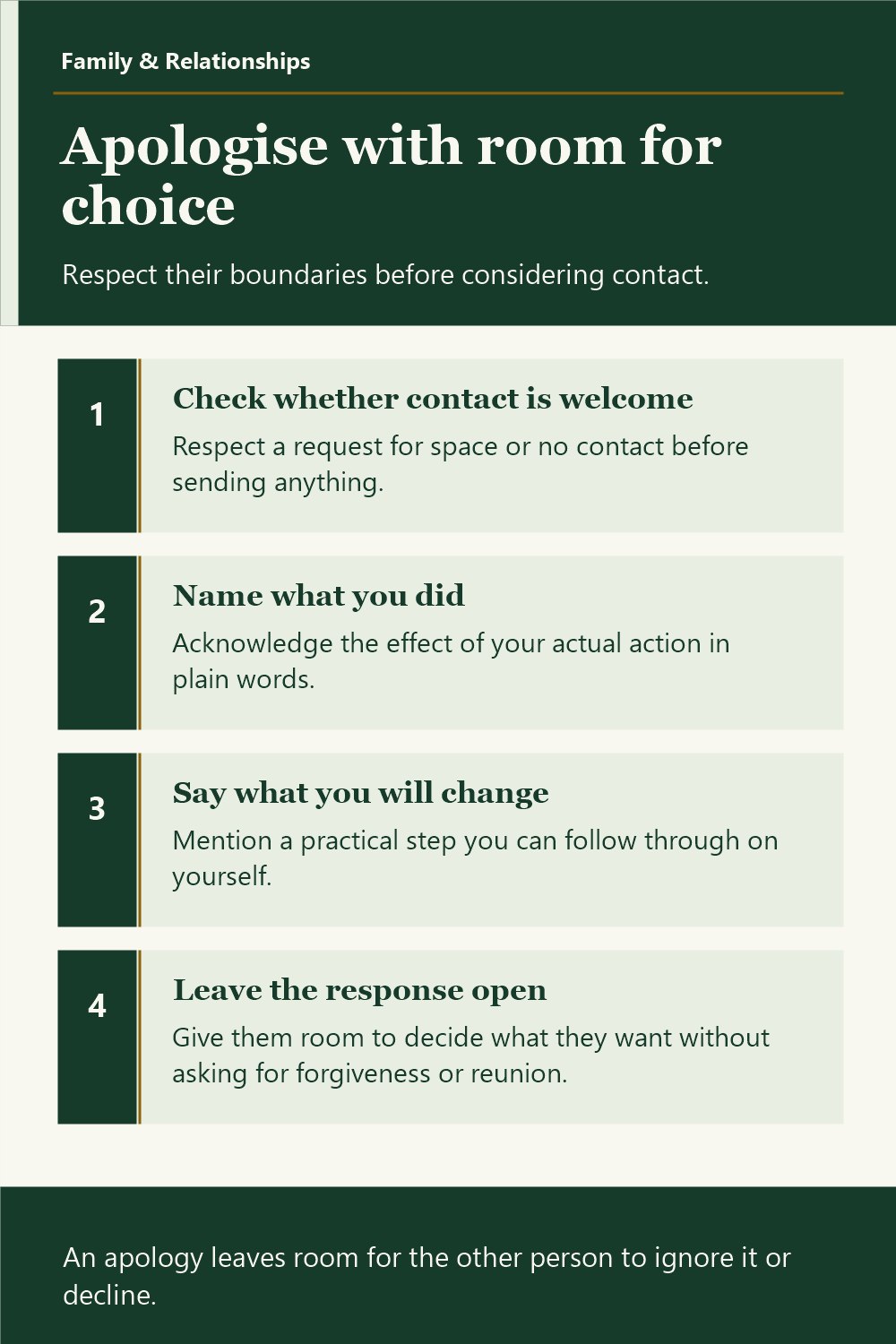
Read the infographic in text
Apologise with room for choice
Respect their boundaries before considering contact.
- Check whether contact is welcome Respect a request for space or no contact before sending anything.
- Name what you did Acknowledge the effect of your actual action in plain words.
- Say what you will change Mention a practical step you can follow through on yourself.
- Leave the response open Give them room to decide what they want without asking for forgiveness or reunion.
An apology leaves room for the other person to ignore it or decline.