

Dating someone who has children can bring affection, companionship and practical questions you have not faced before. A parent’s responsibilities matter, and so do your needs and choices.
Rather than treating the children or an earlier relationship as “baggage,” talk about what family life actually looks like. These conversations can help you decide whether the relationship suits you without asking anyone to compete for first place.
1. What time can you realistically offer each other?
A parent may need to work around school, childcare, work and unexpected changes. Ask what a normal week looks like and when time together is genuinely available.
You could say, “I understand that plans sometimes change. Can we agree to let each other know promptly and suggest another time?” Flexibility works better when both people also respect the other’s time.
Occasional disruption and a repeated pattern of leaving you uncertain are different situations. Discuss the pattern you are experiencing rather than assuming that every cancellation is unavoidable or deliberate.
2. What involvement with the children do you want?
Dating a parent does not automatically make you a babysitter, financial supporter or replacement parent. Be honest about what you are willing to offer and what would feel premature.
For example, you might enjoy an occasional shared outing while not being ready to handle school pickups. The parent remains responsible for arranging care and explaining family expectations.
Your role may develop if the relationship becomes established, but it needs discussion rather than assumption. You can care about the family and still decide that a particular responsibility is beyond your capacity.
3. How will introductions happen without pressure?
Talk together about whether an introduction is appropriate yet, what the child already knows and how to keep a first meeting manageable. There is no reason to rush it simply to prove that the adult relationship is serious.
A short, familiar activity can leave room for a child to be quiet, curious or uncertain. Avoid expecting instant affection, a parental title or reassurance that they approve of the relationship.
Let the parent lead conversations about their child’s needs. You can be friendly and consistent while allowing trust to develop at its own pace.
4. How will you respect co-parenting boundaries?
Contact with a child’s other parent may be part of ordinary parenting. Ask about the arrangements that affect your shared plans without assuming that contact means romantic interest.
Discuss concerns with your partner privately. Do not ask a child to carry messages, report on the other household or take sides in an adult disagreement. The American Academy of Pediatrics’ guidance on separation explains why keeping children out of adult conflict matters.
You do not need to resolve disputes between the parents. If tensions affect you, describe that effect and ask what boundary or practical arrangement your partner can make.
5. Do your plans for the future fit?
Being a parent does not tell you whether someone wants more children, marriage, shared housing or a particular kind of partnership. Ask rather than drawing conclusions from their existing family.
Share your own hopes plainly: “I would like children of my own,” or “I want a committed relationship, but I do not want to live together.” Neither person has to promise something they do not want.
Before major changes, discuss money, space, routines and expectations carefully. Children’s needs and each adult’s capacity belong in that conversation.
6. Can you choose this relationship freely?
You are allowed to decide that the relationship does not fit your life, even when you like the person. That choice does not require judging the parent, their children or yourself.
If you continue, look for mutual care alongside family responsibilities: being heard, keeping workable agreements and having room to raise a concern. Parenting should not become a reason your feelings can never be discussed.
Choose one conversation to begin with. Clear expectations give you more useful information than trying to prove you can cope with everything at once.
Read the infographic in text
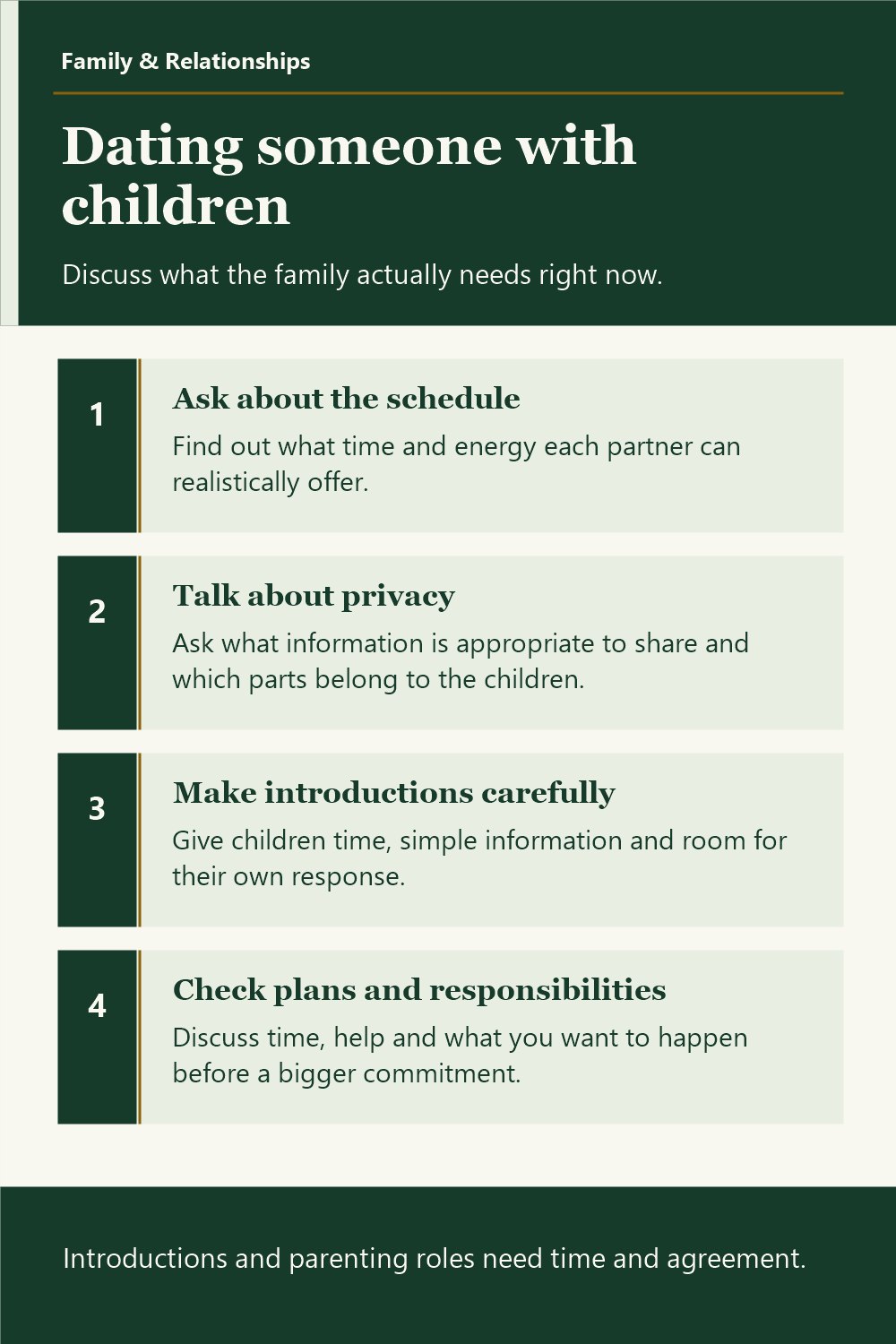
Dating someone with children
Discuss what the family actually needs right now.
- Ask about the schedule Find out what time and energy each partner can realistically offer.
- Talk about privacy Ask what information is appropriate to share and which parts belong to the children.
- Make introductions carefully Give children time, simple information and room for their own response.
- Check plans and responsibilities Discuss time, help and what you want to happen before a bigger commitment.
Introductions and parenting roles need time and agreement.